Steven Murphy / Earthism / Earth Tax
AI Infrastructure: Narrative, Necessity, and the Reality
The current narrative around artificial intelligence (AI) infrastructure is presented with an air of inevitability. We are told that we must build more data centres, that we must expand compute capacity, and that humanity’s future somehow depends on planetary‑scale processing power. The story is confident, polished, and repeated often enough that it begins to feel like truth. AI, we are told, will make us more productive, more competitive, more efficient. And if that requires vast new data centres — even off‑planet ones — then so be it. Progress demands it.
The proposed benefits are framed as universal. Faster computation, smarter systems, economic growth, scientific breakthroughs, global competitiveness — these are presented as unquestionable benefits. The implication is that more compute automatically equals more progress, and that progress automatically equals human flourishing. It is a neat, tidy equation. Too tidy, perhaps.
Because before accepting this narrative, it is worth asking a simpler, more fundamental question: do we actually need these data centres? Not in the commercial sense, not in the competitive sense, but in the human and planetary sense. What do they actually do? A data centre is, at its core, a building full of servers that store data and run computations. Useful, certainly. Convenient, absolutely. But essential for human survival? No. Humans need water, food, soil, breathable air, stable ecosystems and social cohesion, data centres do not provide any of these. They are tools, not lifelines.
Once we ask whether we need them, the disbenefits come into sharper focus. Endless data‑centre expansion carries environmental costs — enormous water consumption, heavy energy demand, rare‑earth mining, e‑waste, and land pressure. It carries social costs — rising energy prices, infrastructure strain, and the quiet displacement of communities. And it carries a deeper human cost that is rarely spoken aloud: to recover the investment, companies must reduce costs elsewhere.
Data centres are not philanthropic ventures. They are capital assets funded by shareholders who expect returns, and used by companies who must demonstrate earnings growth. The people pushing the narrative of inevitability are not neutral observers; they are the financial beneficiaries. They are the investors, the funds, the market participants who have already placed their bets. And like all investment‑driven narratives, this one carries an unspoken truth: those who promote it will be long gone before the real impact is felt. They will have exited with their returns, diversified their portfolios, and insulated themselves from the consequences. The costs — social, environmental, and human — will fall on those who had no say in the investment decision.
If you look at the stock markets today, the pattern is clear. The daily highs, the surges in valuation, the sudden creation of trillions in paper wealth — almost all of it is tied to AI‑linked companies. Meanwhile, the real economy of making and selling goods remains stagnant. Manufacturing is not booming. Retail is not booming. Productivity in most sectors is flat. Without the hype, without the liquidity, without the monetary expansion that has quietly supported asset prices for over a decade, it is difficult to imagine this bull run sustaining itself.
Yet the narrative insists that AI is the engine of a new economic era. It insists that more data centres, more compute, more automation are the only path forward. But this narrative is not being driven by necessity. It is being driven by capital. And capital has expectations. Companies that invest billions into AI infrastructure must justify those investments. They must show earnings growth. They must deliver returns to shareholders. And when revenue cannot rise fast enough to meet those expectations, costs must fall. The largest cost in most organisations is labour. The logic is simple, and it is structural: the more expensive the infrastructure, the greater the pressure to reduce the human workforce.
The promise of “productivity and efficiency” is presented as if it benefits everyone equally. But the assumptions beneath it are never examined. It assumes that we need to be more productive, that we have more work than we can handle, that customers are waiting because we cannot process or produce fast enough. It assumes that efficiency gains will flow to the same populations who are funding the transition. It assumes that the benefits will be shared. None of these assumptions are being challenged.
The reality is that many sectors are not constrained by productivity; they are constrained by demand. Making processes faster does not create new customers. Automating tasks does not create new purpose. And yet the system continues to expand compute capacity as if human labour is the bottleneck, when in many cases, it is not. The result is a widening gap between those who benefit from the AI narrative and those who bear its consequences. The beneficiaries are insulated. The displaced are not. We already have millions of people sitting idle, not because they lack ability, but because the system no longer has a place for them. What happens when even more are displaced? What purpose will they have? What role will society offer them? These questions are not part of the AI narrative, yet they are central to the human reality.
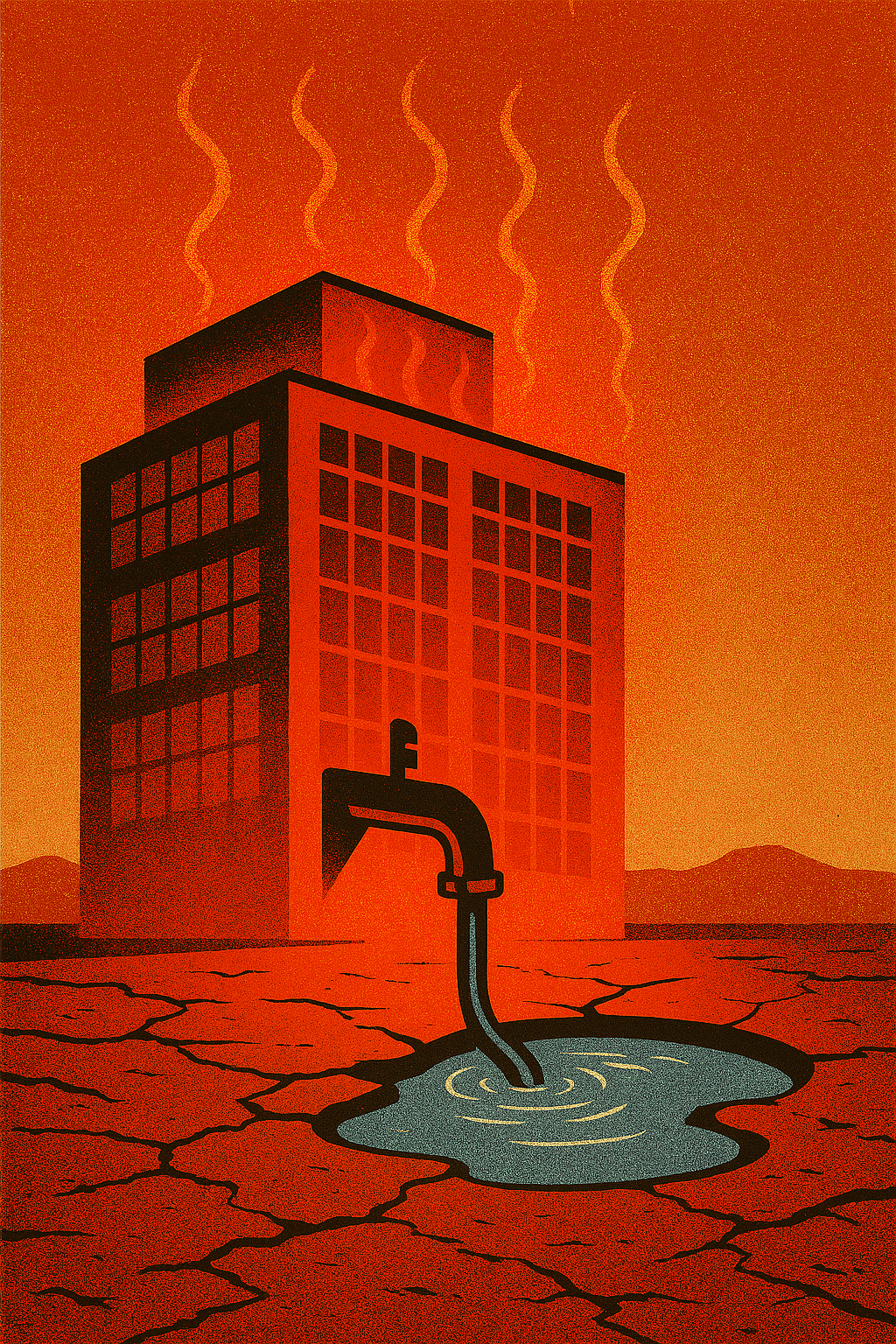
And then there is the environmental contradiction at the heart of the entire project. Data centres run hot — extremely hot. They require vast cooling systems to remain operational. On a planet that is already warming, is it sensible to build infrastructure that generates even more heat? The proposed solutions — cooling with water, cooling with air — are presented as if they are harmless. But water is not infinite. Air is not free of consequence. Diverting water to cool servers means diverting it from agriculture, ecosystems, and communities. Using air cooling means releasing heat back into an atmosphere we are already struggling to stabilise. The narrative treats these trade‑offs as trivial. They are not.
To make the cost logic tangible, consider something as ordinary as moving goods on UK roads. A single articulated lorry can move around twenty‑six tonnes of goods from Derby to Birmingham — roughly forty miles — for around £250 to £300. That is one movement, on existing roads, using mature infrastructure. Even that is not cheap. Now extend that logic off‑planet. Public space‑industry figures suggest that moving one kilogram to the Moon costs tens of thousands of pounds, and moving one kilogram to Mars costs hundreds of thousands. Twenty‑six tonnes to the Moon becomes hundreds of millions of pounds. Twenty‑six tonnes to Mars becomes billions. And that is only transport — not construction, cooling, shielding, power, robotics, or maintenance. The numbers stop being ambitious. They become economically incoherent.
Meanwhile, Earth faces realities that cannot be deferred. Declining biodiversity, soil degradation, water scarcity, rising waste, unstable population dynamics, and economic incentives that reward destruction — these are the challenges that shape our actual future. They are problems we can influence. We could stabilise population growth, reduce waste, protect ecosystems, restore soil and water, align economic incentives with survival. These are real levers with real impact, Off‑world data centres do not address any of them.
The narrative says we must build more data centres — even off‑planet — to secure humanity’s future. The reality is simpler. Data centres are tools, not necessities. Their expansion carries real costs. Off‑world infrastructure is economically incoherent. And none of it helps save the only biosphere we have. We do not need to chase speculative futures to survive. We need to protect the Earth that already sustains us — and ensure that the humans living on it still have purpose, dignity, and a place in the world we are building.
In the end, the question is not whether we can build ever‑larger engines of computation, but whether doing so brings us any closer to a stable planet and human future. The answer may lie not in the clouds or on distant planets, but in the ground beneath our feet — in the systems we choose to build, the incentives we choose to reward, and the value we place on the only world that can sustain us. Rushing head‑first into the unknown carries social, environmental, and planetary consequences — the true impact has yet to reveal itself.
See CHOICE GB – Economy / Environment