Steven Murphy / Earthism / CHOICE GB / Earth Tax
Immigration – It’s A Mathematical Problem.
The UK’s Number’s Don’t Add Up
If we’re being straight with each other, immigration isn’t the mystery people pretend it is. Everyone talks about it — in pubs, at work, on the news, online — and everyone says the same thing: “Why won’t they stop it?” Every government promises to reduce it, every government quietly lets it rise, and every government hopes nobody notices. People think it’s ideology or incompetence or cowardice. But the truth is simpler, and far more uncomfortable.
Immigration isn’t being controlled because the country can’t afford to control it. It’s not a moral issue or a humanitarian issue, it’s a mathematics problem. The UK’s financial numbers don’t add up.
We’ve built social systems that cost more than we’re willing to pay for. Pensions, healthcare, welfare, disability support, housing support, childcare, long‑term care — the whole thing. The financial promises are bigger than the tax base. And because the State Pension System has no savings behind it, the only way to keep the whole thing upright is to keep adding more working‑age people who can pay tax today.
That’s the part nobody says out loud. Immigration isn’t rising because politicians want it to, it’s rising because the system needs it to. Without a steady flow of new workers, the tax base shrinks, the pension costs grow, and the whole model falls over in plain sight. Immigration has become the pressure valve for a system that’s already financially underwater.
But here’s the twist: even with today’s high immigration levels, the numbers still aren’t improving. The deficit is rising, the national debt is rising whilst the dependency ratio is worsening. That tells you everything. If immigration were the solution, the numbers would be getting better. They aren’t. Which means the current levels aren’t high enough to stabilise the model.
And this is where the governments story collapses. They’ve tried to convince us that every immigrant is an instant taxpayer, a net contributor, a boost to the system. But that’s not how it works. Some do contribute, some start businesses, some fill shortages. But many arrive with families who need support. Others join households already dependent on the state. Many work in low‑wage sectors where tax contributions are tiny. A significant number never become net contributors at all.
But the political narrative treats every arrival as if they’re a surgeon or an engineer. The reality is that a large share become part of the dependent population, not the contributing population. And because the system is already running a structural deficit, every additional dependent increases the pressure.
If the assumption were correct — if every new arrival were a net contributor — the numbers would be improving. But they aren’t. The gap is widening. The pressure is increasing. The system is becoming more fragile, not less.
And underneath all of this is a deeper truth: the way we run the country is built on fantasy. We’ve been living on Disney‑world economics layered on top of Venezuelan‑style financial management. We spend like a rich country, tax like a poor one, and borrow like a desperate one. We’ve convinced ourselves that being British comes with a get‑out‑of‑reality ticket — that the laws of mathematics don’t apply to us.
We think we don’t have to live within our financial limits, that deficits and debts don’t matter, that we can have everything without having to balance the books. And when anyone suggests we might have to pay more, or consume less, or accept limits, we scream and shout like a child denied an ice cream, or like a drug addict parted from their needle. We behave as if something outrageous has been done to us and act as though we are entitled to a version of life that doesn’t exist anywhere in the arithmetic.
The fact is that the arithmetic doesn’t care, it’s a mathematics problem. The numbers don’t add up and they haven’t added up for years, it’s not fiction, it’s the reality. And because we refuse to face that, we’ve been passing the consequences onto our children and grandchildren. We’re handing them a bill for our comfort, our consumption, and our refusal to accept limits. The penny hasn’t dropped yet, but it will. And when it does, when they finally confront us, what exactly are we going to say?
“Sorry, but I wanted to keep the party going.”
“Sorry, but I didn’t want my lifestyle to change.”
“Sorry, but like a drug addict, I couldn’t stop.”
“Please forgive me.”
This is why blame matters. Not to shame anyone, but because if no one is responsible, then nothing has to change. If we keep pretending the system drifted into trouble on its own, then we give ourselves permission to carry on exactly as we are — expecting more than we put in, complaining when the numbers don’t add up, and acting shocked when the gap gets filled by debt, immigration, or cuts.
And this is where the State Pension System comes into view. Most people don’t know this, but the UK has no state pension pot, no savings or national investment fund. Every pound paid to a pensioner comes directly from taxes collected from the people working right now. It’s a conveyor belt. It only works if there are always enough new workers entering the base to support the people drawing from the top. A form of Ponzi scheme.
That’s why immigration is used to support the system, it’s presented as a source of new workers and new taxpayers. But the assumption that every new arrival will be a net contributor is flawed. When the system is already in deficit, adding more dependants increases the strain. The model becomes reliant on ever‑larger inflows of new people simply to slow the rate of decline.
And the numbers behind the pension system are brutal. We have roughly 33 million people in work and around 12 million pensioners. But around 8.5 million of those workers are paid from tax — public sector workers, NGOs, and other tax‑funded roles. They’re counted as “in work”, but they’re not net contributors. Their wages come out of the pot; they don’t pay into it.
Strip them out, and the real number of net contributors is closer to 24.5 million. That means the true ratio is not three workers per pensioner, but closer to two. And even with that ratio, the system is already struggling. We’re running huge deficits, adding debt, and relying on immigration to slow the rate of decline.
Now look forward 40–50 years. A 20‑year‑old today will retire into a world with more pensioners and fewer workers. If the population stays the same, the number of pensioners rises from around 12 million to something closer to 18–20 million. But the number of net contributors won’t rise with it. It will stay roughly where it is, or fall. That collapses the ratio from two net contributors per pensioner to something closer to one.
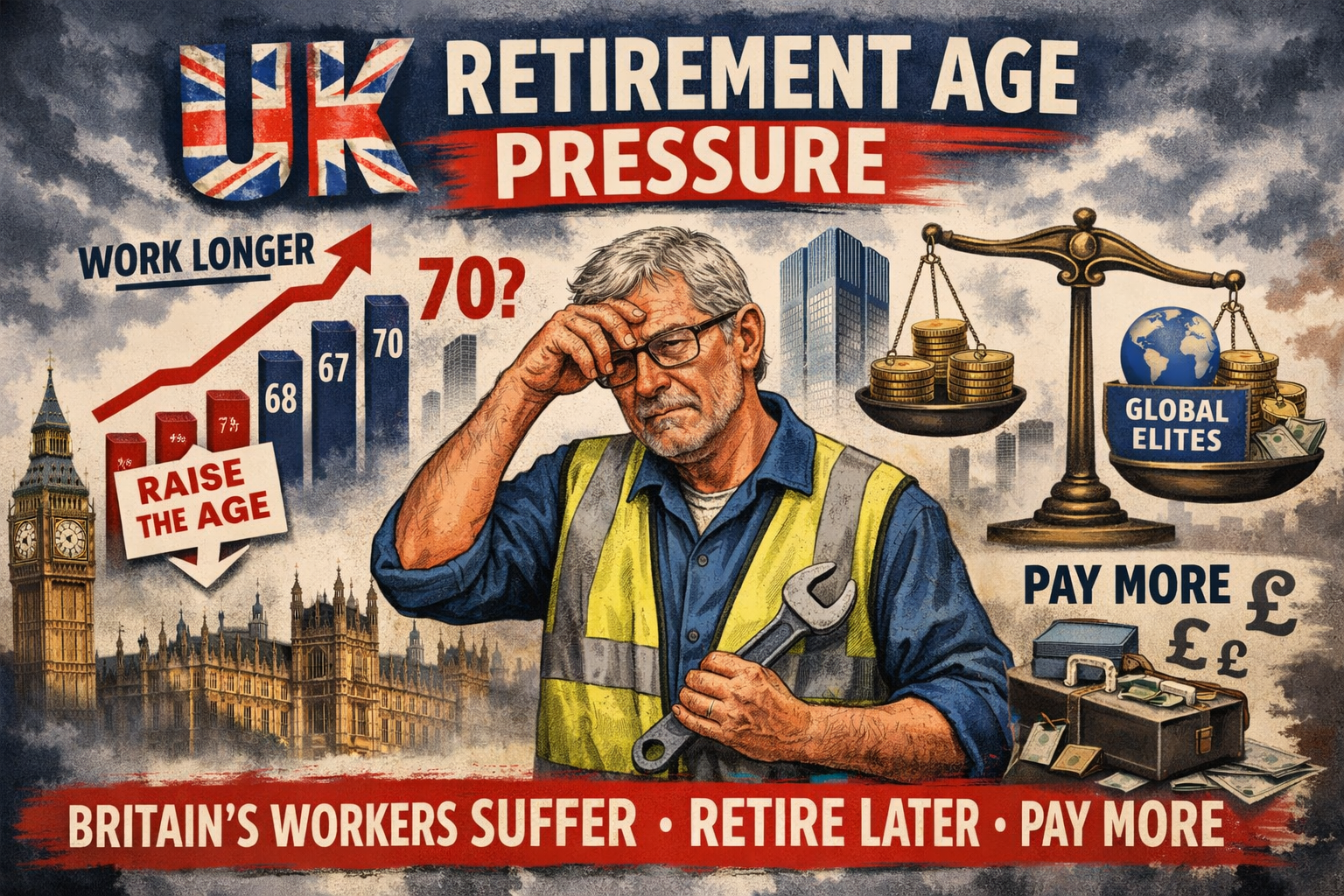
Our current pay‑as‑you‑go pension system cannot survive on these numbers. To give a 20‑year‑old today the same pension on today’s tax and debt settings, the system must reduce the number of years each person draws a pension. That means raising the retirement age. Today, people draw a pension for roughly 19 years. With the future ratio collapsing to around 1.2 net contributors per pensioner, the system can only afford about 60% of today’s pension duration. That means around 11 years of pension instead of 19. If life expectancy for a 20‑year‑old today is around 92, then the retirement age would need to rise to around 81 just to keep the system solvent. If life expectancy rises further, or if the number of net contributors falls, the retirement age moves into the mid‑80s.
So whether you look at the problem through the lens of population growth or retirement age, the conclusion is the same. To give a 20‑year‑old today the same pension on today’s tax and debt settings, the UK would need either a population approaching 120–130 million people or a retirement age between 81 and 85. Anything lower requires much higher taxes or much lower pensions.
This is why immigration isn’t being controlled or stopped. Not because of laws or human rights. Because the country has already promised to pay out more than it can afford at current tax levels. The system only works if the population grows forever or if people work forever. Neither is possible. And until that truth is faced, immigration will continue, retirement ages will rise, and the youngest generation will carry the burden of a social model that was never redesigned for the world they are living in.
And then there’s the land itself. The UK cannot feed itself. It hasn’t been food‑self‑sufficient for decades. Even with modern farming, imports account for nearly half of all food consumed in the country. The more people the UK adds, the more exposed it becomes to global supply chains, geopolitical shocks, and price volatility. A country that cannot feed its current population cannot pretend it can absorb millions more without consequence.
The current economic model depends on continuous expansion — more people, more consumption, more production, more activity. But every unit of consumption has a cost, and every unit of waste has a destination. The UK’s land, water systems, and agricultural capacity are already under strain. Soil quality is declining, rivers are polluted, farmland is being lost to housing. We import energy, food, fertiliser, and labour. These are not theoretical warnings. They are signs that the model of perpetual expansion is colliding with the physical limits of an island nation.
When the economic model, the demographic model, and the ecological model all require expansion to remain stable, but the physical world cannot support that expansion, the system reaches a point where the assumptions underpinning it no longer hold. That is where the UK now finds itself. The promises exceed the revenues. The population exceeds the carrying capacity of the old economic logic. And the ecosystem is signalling that the model of endless growth has reached its natural limits.
Can the UK’s land and ecosystem absorb another 30–40 million people to help pay for the current levels of societal spending?. No.
To sort this out is going to take more than frenzied political rhetoric, it’s going to require a total rethink and behavioural change, not seen in the UK for decades. But for the current herd of politicians and the British public, it’s business as usual — immigration, more immigration, onwards, upwards, and bust.
See CHOICE GB – Welfare