Steven Murphy / Earthism / Earth Tax / CHOICE GB
THE MEDITERRANEAN
A REGION LIVING BEYOND ITS NATURAL LIMITS
When society talks about the environment, we often think about rubbish, plastic, CO₂ emissions, and the pollution of rivers, lakes, and oceans. We see it at arm’s length. We are aware of it, and in some small way we try to be more planetary‑sympathetic. We split our waste into categories. We buy electric cars. We choose goods in recycled packaging. We do our best — or at least we tell ourselves that we do. But is that the truth. Are we really doing our best. Or are we performing a kind of polite, socially acceptable environmentalism that makes us feel responsible without ever challenging the systems that cause the damage in the first place. Only you will know, and only time will tell.
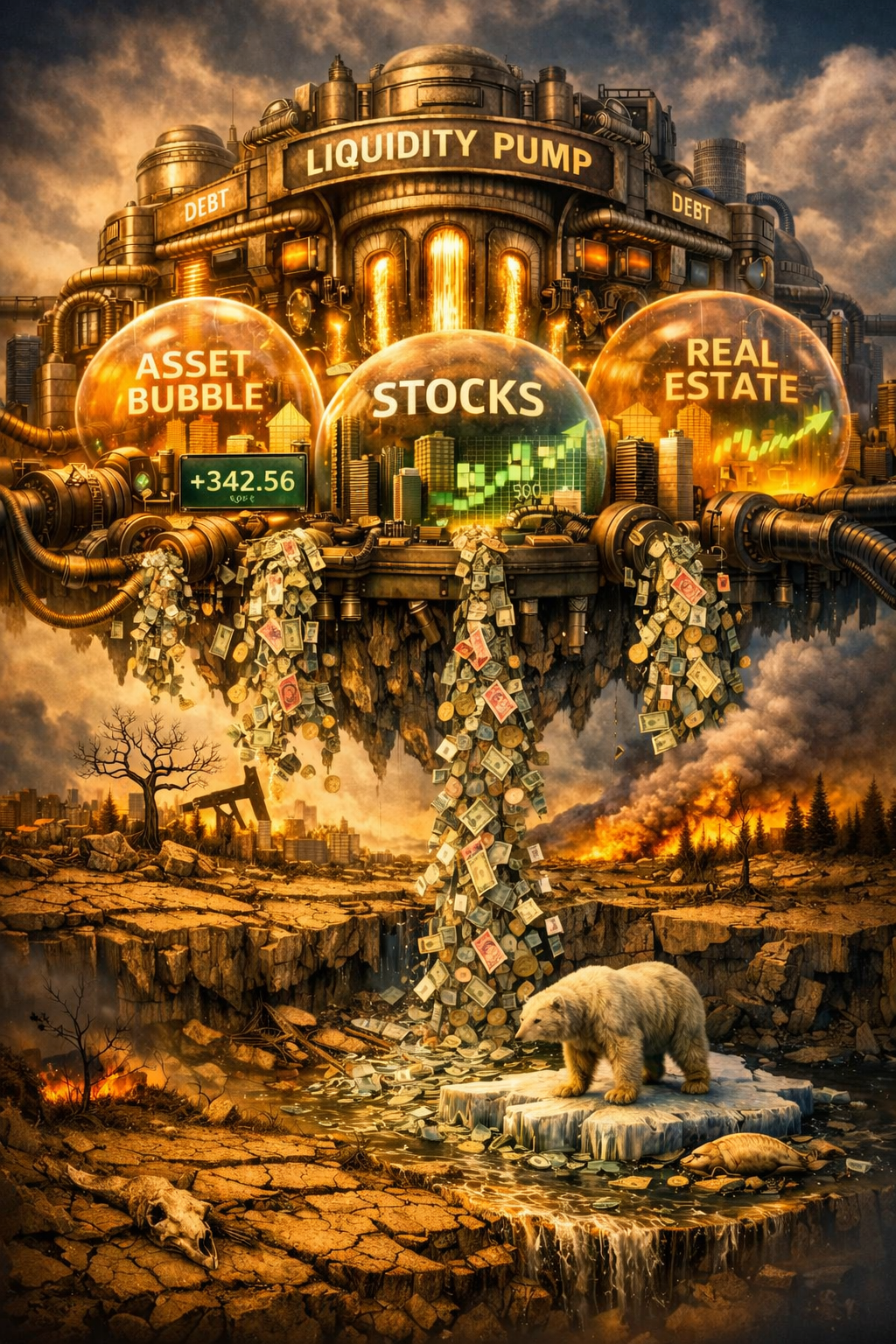
Because quite often, the real damage is hidden from view. No mention, no discussion, no media coverage or political debate. And the reason is simple: the most destructive impacts on our environment all emanate from one source — humans. Us. The politics we follow, the behaviours we endorse, the mindsets we develop, encourage, and educate. The reality is that almost every society on Earth has some form of environmental policy, some approach, some strategy. But none of them are directed at the real problem: human demand. From encouraging population growth, to pushing economic expansion, to relying on monetary engineering like quantitative easing and interest‑rate manipulation to keep the engine running, none of these tools are designed to apply constraint. They are designed to service our never‑ending appetite for more — more excess, more ease, more of everything.
And as we move into the northern hemisphere summertime, it is worth examining one area of destruction that is rarely discussed. It is happening twenty‑four hours a day, three hundred and sixty‑five days a year. It never stops. And unless we change our behaviour, it never will. It is one of the most devastating activities we undertake, and yet it remains almost entirely invisible. The process of desalination.
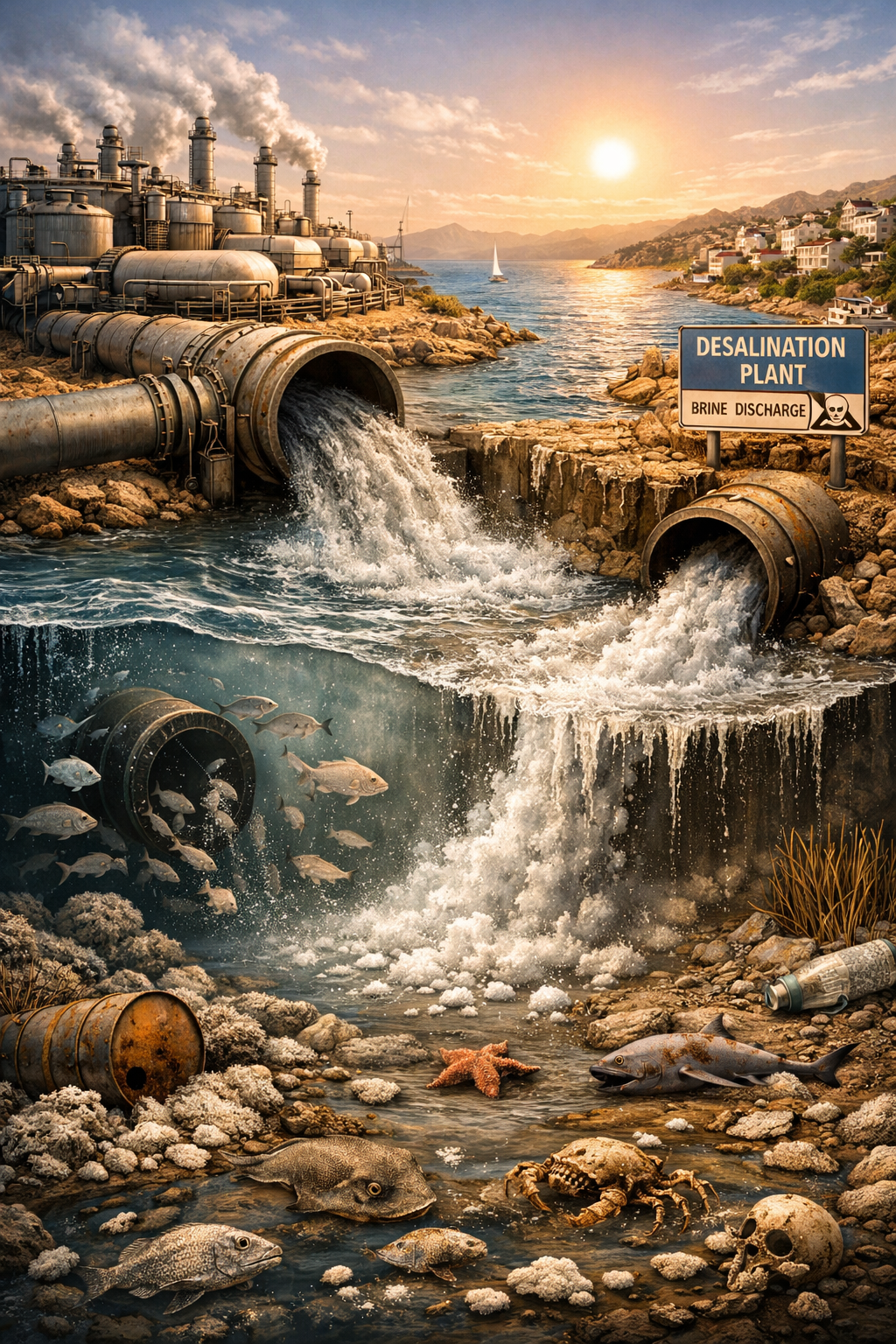
Across the Mediterranean coastline, something extraordinary is happening — quietly, mechanically, and almost entirely out of public view. Vast desalination plants pull seawater from the sea every hour of every day, converting it into fresh water for cities, farms, and industries that have long since outgrown the natural limits of their landscapes. The scale is staggering, yet almost no one sees it. One plant alone can produce 84,851 cubic metres of water per day — enough to fill around forty football stadiums every single day, or the equivalent of 8,500 tanker trucks stretching for around 100 kilometres, about sixty‑two miles, every single day. And that is just one facility.
Across the Mediterranean region, there are now hundreds of desalination plants operating along the coasts of Spain, Israel, Algeria, Morocco, Tunisia, Egypt, Cyprus, Malta, Libya, and Greece. Greece alone operates 147 desalination plants, the highest number in the Mediterranean, supplying islands and coastal towns that can no longer rely on natural rainfall. Spain — one of the UK’s most popular holiday destinations — operates 54 desalination plants, providing essential water to its Mediterranean coastline, islands, and tourism centres. Collectively, these facilities produce millions of cubic metres of water every single day, an industrial volume so vast that it would take thousands of football stadiums to hold it, or a convoy of hundreds of thousands of tanker trucks stretching across entire countries. This is not a marginal technology. It is the hidden infrastructure keeping Mediterranean societies — and their tourism economies — alive.
But desalination does not run on goodwill or sunlight alone. It is one of the most energy‑intensive processes we have ever normalised. Every litre of fresh water requires vast amounts of electricity, and in much of the Mediterranean that electricity still comes from fossil fuels. So the very process designed to compensate for drought contributes to the warming that intensifies the drought. More heat means more water scarcity. More scarcity means more desalination. And more desalination means more energy, more emissions, more heat. A second self‑defeating loop, running silently alongside the first.
And yet, despite all of this, the instruction remains the same: grow. Governments insist population numbers must rise to support pension systems and labour markets. Economists warn that without economic expansion, societies will stagnate. The message has not changed in generations: more people, more consumption, more output. But no one asks the question that the Mediterranean makes unavoidable — where will the water come from. The land cannot supply the water for the people already here. The machines are already running at capacity to sustain the demand of today. And still, the call is for more.
Every comfort the tourist enjoys — every shower, every pool, every cold drink, every rinse after the beach — is paid for by the sea’s ecosystem. The brine, the chemicals, the heat, the energy, the extraction: all of it is pushed back into the water you are floating in, the water you photograph at sunset, the water you believe is timeless and untouched. It absorbs the cost so you do not have to.
And here lies the absurdity: the damage is permanent, but the demand is seasonal. Millions arrive for a few weeks of sun, comfort, and escape, and the infrastructure required to serve that temporary pleasure runs all year. The sea is degraded continuously so that tourists can enjoy it briefly. A temporary luxury paid for by a permanent loss.
While you relax, the sea is working. It absorbs millions of tonnes of concentrated waste every year so that hotels can stay full, golf courses can stay green, and cities can keep expanding. The fish, the seagrass, the microorganisms, the entire food web — they are the ones paying the price for our convenience. The Mediterranean is a semi‑closed basin; it cannot flush itself clean. What goes in stays in. The ecosystem suffocates quietly so that civilisation can pretend everything is fine. The damage is invisible to the tourist, but not to the sea or the creatures that live in it.
And this is where the argument becomes more than environmental. It becomes a question of rights. Because the Mediterranean does not belong to the nations that border it. It is a shared basin — territorial waters, overlapping economic zones, and large stretches of international sea that belong to no one and affect everyone. Each nation extracts from the narrow strip it legally controls, but the consequences do not respect those lines. When one coastline takes more than nature can replace, the deficit is pulled silently from the Atlantic through the Strait of Gibraltar — not by agreement, not by design, but because physics does not recognise borders. The shortfall is exported. The benefit is kept. And a shared global system absorbs the cost of local excess.
Legally, each nation has permission to take what it wants from the waters it controls. But legality is not the same as legitimacy. No one voted for this arrangement. No one agreed to it. No one asked the Atlantic whether it was willing to subsidise Mediterranean excess. Yet that is exactly what is happening — and the question it raises is one that international law has not answered, and governments have not asked: what gives any nation the right to drain a shared sea, and export the consequences to an ocean that belongs to everyone.
And beneath all of this sits a political truth that no government will admit: no administration has an incentive to reduce demand. Voters punish scarcity. Politicians promise abundance. Growth is the currency of legitimacy, and desalination is the safety valve that allows governments to avoid confronting limits. As long as the machines keep running, the illusion of control remains intact. The ecological cost is invisible, and invisibility is politically convenient.
But even this is only a symptom. The deeper problem is not desalination. It is the behaviour that makes desalination necessary. If populations were stabilised or reduced rather than encouraged to grow, if economies were designed to operate within environmental limits rather than expand without end, if societies accepted that the planet has boundaries rather than treating it as an infinite service provider, then the pressure on the Mediterranean would fall. The machines would not need to run day and night. The sea would not need to be drained and refilled. The Atlantic would not need to compensate for the choices of others. It always comes back to the same point: human behaviour. Human demand. Human refusal to accept limits. Until that changes, nothing else will.
Because the Mediterranean is not an anomaly. It is a preview. A warning signal flashing ahead of the rest of the world. What is happening here will happen elsewhere — in regions that still believe they are safe, still believe their rivers will flow forever, still believe their aquifers will refill. The Mediterranean is simply the first place where the limits have arrived early. The rest will follow.
We may be clever enough to build the machines that make all of this possible — clever enough to force the sea to give us water it never intended to give, clever enough to engineer our way past every natural limit we encounter. But cleverness is not intelligence. Cleverness solves the problem in front of it. Intelligence looks at the causal factors — what created the problem in the first place — and then examines what the proposed solution creates behind it.
Cleverness builds desalination plants. But is it intelligent to construct a solution that poisons the ecosystem you are extracting from? The brine discharged back into the sea increases salinity, raises water temperature, and depletes oxygen. It disrupts the very marine conditions that coastal life — human and non‑human alike — depends upon. So the solution to water scarcity degrades the water source. The fix accelerates the problem it was built to fix. This is not progress moving in a straight line. It is a circle, and we are tightening it.
There is a word for this pattern: it is called a self‑defeating system. A system in which the solution sustains the problem, and the problem justifies the solution. More people require more water. More water requires more desalination. More desalination damages the marine environment. A damaged marine environment reduces the natural capacity to support life — which increases the pressure on artificial systems to compensate. We build more plants. We extract more. We discharge more. And the sea, already weakened, absorbs more damage. At no point in this cycle does anyone ask whether the cycle itself is the problem.
And this is the uncomfortable truth: we are a clever species, but not an intelligent one. We invent technologies to escape the limits we create. We design systems to hide the damage we cause. We build solutions that allow us to continue the behaviours that created the problem. We call this progress, but it is not progress — it is avoidance. It is the refusal to confront the reality that our demand is the problem, not the sea, not the climate, not the environment. The sea is not failing us. We are failing it. And in doing so, we are failing ourselves.
Cleverness allows us to keep going. Intelligence would ask whether keeping going is the point. But we don’t stop, we accelerate, we expand. We congratulate ourselves for our innovations while ignoring the destruction they mask. We celebrate our ability to extract more, consume more, build more, travel more, grow more — as if the planet beneath us is an infinite foundation rather than a finite system already showing signs of strain. We treat the Earth as if it were a service provider, not a living system. We behave as if consequences are optional, as if limits are negotiable, as if nature will always bend to our will. It won’t.
We are a species in denial, no constraints, no limits. A master species that has given itself free range to destroy the ecosystem. We behave as if nothing can touch us, as if the rules that govern every other species somehow do not apply to us. But the clock is ticking. The planet does not have infinite resources. For every yin there is a yang. For every action there is a consequence. Nature keeps its own balance sheet, whether we acknowledge it or not.
And just like the damage we are causing — hidden from view, buried beneath the surface, pushed out of sight so we don’t have to confront it — the consequences will be the same. Quiet at first. Distant. Easy to ignore. Until they are not. Until they arrive in full, undeniable clarity. Until the system we have pushed beyond its limits finally pushes back.
We pretend we are separate from the environment, but we are not. We pretend we can take without giving, extract without restraint, consume without consequence. But the bill always comes. The only question is when.
And there is another truth we rarely speak aloud: the people who will inherit this damage have no voice in the decisions that create it. Future generations cannot vote. They cannot object. They cannot negotiate the terms of the world they will be born into. Yet they will live with the consequences of choices made long before they existed. We treat their future as collateral — something to be spent, consumed, and depleted in service of our present comfort.
Enjoy it while you can. Those yet to be born may not have this luxury.