Steven Murphy / Earthism / Earth Tax
Illegal Immigration: The War on National Governance and Democracy
Immigration has become one of the most emotionally charged issues in British public life, yet it remains one of the least understood. The public sees small boats crossing the Channel, hotels filled with asylum applicants, overstayers working in the shadows, and political promises that never materialise. The natural conclusion is that the system is broken because nobody is doing anything.
The truth is more uncomfortable.
The UK’s immigration system is not failing through inaction. It is failing because it is built on legal frameworks the public never voted for, operational constraints nobody explains, and international obligations written by unelected bodies, decades before today’s migration realities existed.
To fix the system, we must first understand it.
Illegal Entry and Asylum: The Legal Distortion
This is the first major point of confusion. A person can enter the UK illegally — by boat, lorry, or false documents — and live here undetected for years. But the moment they claim asylum, they are no longer treated as an “illegal immigrant” under UK law.
Once asylum is claimed, the government is legally required to:
- house them
- feed them
- provide healthcare
- process their claim
- protect them from removal until a decision is made
This is not a political choice, it is the result of international treaties and domestic legislation built on top of them. The public sees “illegal immigrants in hotels”, but legally, they are not considered illegal once they claim asylum. This single legal distinction drives much of the confusion.
Maritime Law: The Structural Trap
Public debate often imagines a “grey zone” in the Channel where the UK could intercept boats and tow them back. No such zone exists.
French territorial waters (0–12 miles from France), France has full control. The UK cannot intervene, even if a boat is clearly heading for Britain.
UK territorial waters (0–12 miles from the UK), the UK becomes responsible under maritime law.
UNCLOS, SOLAS, and SAR conventions require the UK to:
- rescue anyone in distress
- respond to all distress calls
- deliver rescued persons to a place of safety
- coordinate with France
These conventions were designed for shipwrecks, fishing accidents, and commercial vessels — not organised smuggling in inflatable dinghies. But the obligations are absolute. Because the dinghies used by smugglers are unseaworthy by design, they are legally considered “in distress” the moment they leave France. That triggers rescue obligations.
This is why:
- pushbacks are unlawful
- Border Force must intervene
- migrants are brought to UK shores
- asylum claims must be processed
There is no point between France and the UK where British authorities, can legally tow boats back once they have departed French waters.
There is no free‑action zone. Once someone reaches UK waters or soil and claims asylum, the UK loses almost all leverage.
The Democratic Deficit: Rules Nobody Voted For
Two truths are rarely acknowledged.
First, today’s rules were written by non‑UK, unelected international bodies, often decades before small‑boat migration existed.
Second, we are applying mid‑20th‑century rules to a 21st‑century migration crisis — and pretending the mismatch doesn’t matter.
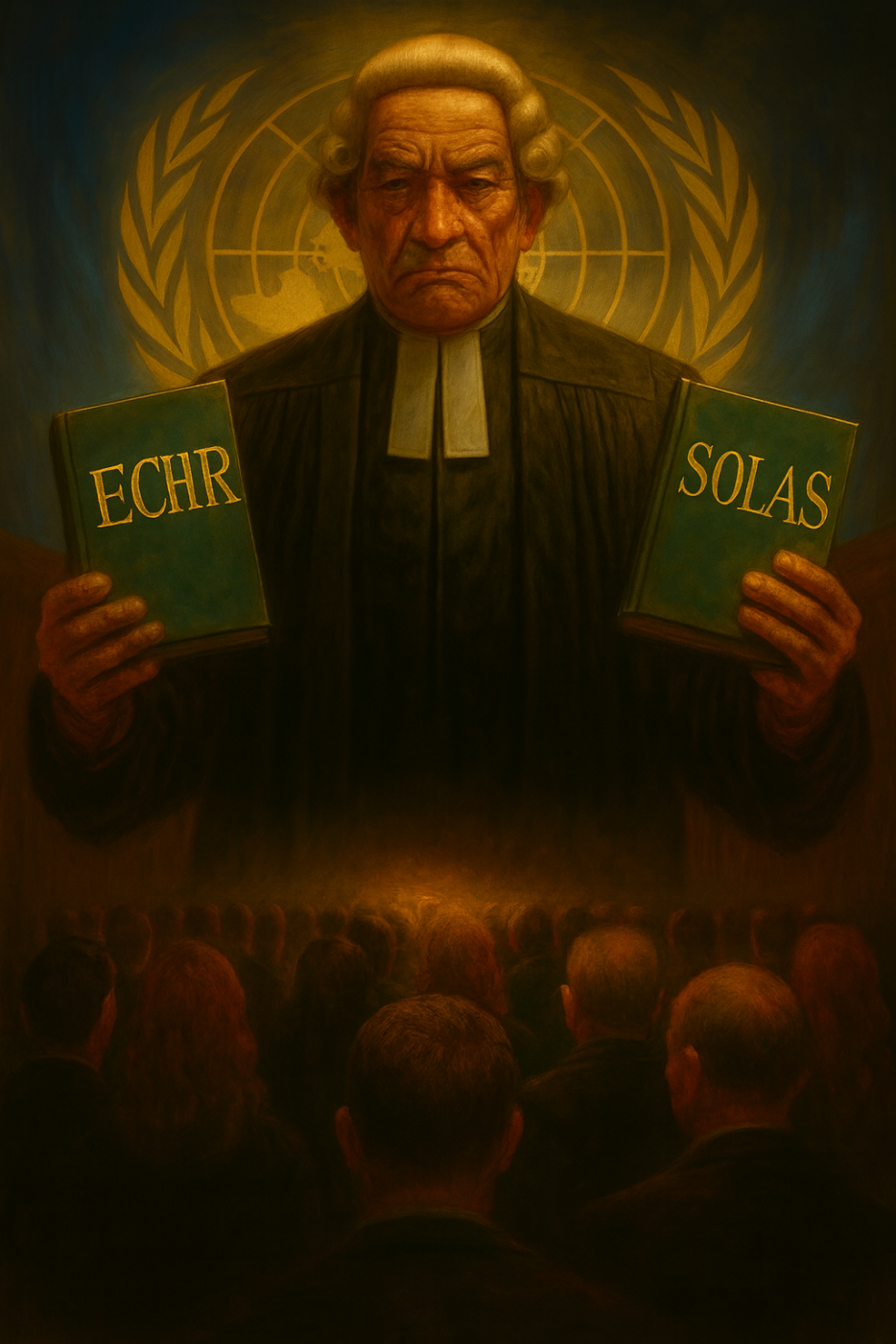
The United Nations and the Council of Europe — the organisations behind the International Maritime Organization and the European Convention on Human Rights — now play a decisive role in what the UK can and cannot do, both at sea and on land. Their regulations shape Britain’s response more than Parliament does.
The frameworks governing the UK’s ability to control illegal entry were not created by the British public, nor designed for today’s realities. This creates a democratic problem: the British people are being governed by rules written by non-UK entities for a world that no longer exists.
No election ever put these obligations to the people, no referendum was ever held. These constraints simply appeared — no scrutiny, no consent. If unelected bodies can impose rules without public approval, democracy is not functioning.
It becomes governance through the back door, but one simple truth remains, these rules were written by humans — humans can rewrite them.
The Hard Truth: Voting Alone Will Not Deliver Change
If the UK is serious about regaining full sovereign control over its borders, it must confront a reality that is rarely acknowledged in public debate: our current legal obligations are not purely domestic. They are embedded in international frameworks that limit what any British government can do, regardless of its mandate.
Two institutions sit at the centre of this constraint:
- The United Nations (UN) — through maritime law, refugee conventions, and human‑rights treaties.
- The Council of Europe (CoE) — through the European Convention on Human Rights (ECHR) and the court that enforces it.
These bodies do not operate maliciously, but they do operate externally — above and beyond the democratic choices of the British electorate. Their rules were written for a different era, under different assumptions, and without the consent of the British public. Yet they continue to shape what the UK can and cannot do in the English Channel, in asylum processing, in removals, and in border enforcement.
This is why any meaningful amendment must begin with a simple, unavoidable question:
Does the UK want full sovereign control, or does it want to remain bound by frameworks written elsewhere?
Revisiting these commitments does not mean isolation, hostility or abandoning cooperation. It means re‑establishing democratic primacy — ensuring that the British people, through our elected representatives, have the final say over the laws that govern them.
But here is the hard truth, even if the public votes for change, that change will not be delivered unless the people are prepared to defend it.
Revisiting international commitments will trigger:
- legal challenges
- institutional resistance
- political obstruction
- diplomatic pressure
- coordinated campaigns to reverse or dilute the reforms
This is not hypothetical.
It is the predictable response of any system that has grown accustomed, to operating above national sovereignty. Those that believe in the concept of a United States of the World, with the United Nations as its headquarters will fight any change, any attempt to reduce this entities power will be challenged.
Which is why the British public must understand, voting is the beginning of change — not the completion of it, a democratic mandate must be matched with:
- scrutiny
- accountability
- transparency
- enforcement
- refusal to accept evasion or delay
If the UK chooses to redefine its relationship with the UN or the Council of Europe, it must do so with clarity, discipline, and public backing that does not evaporate the moment resistance appears.
The reality is that sovereignty will not be restored by sentiment. It will be restored by sustained democratic pressure, applied consistently until the system aligns with the will of the people. This is not extremism, it is the foundation of self‑government.
What Must Be Done: A Realistic, Enforceable Framework
Democratic Accountability: The Missing Ingredient
The UK must exit global organisations:
- United Nations
- Council of Europe
- Court of International Law
Political parties must be required to:
- publish detailed plans
- outline timelines
- specify operational steps
- define measurable outcomes
- accept consequences for failure
The public must refuse to accept or tolerate:
- ambiguity
- misdirection
- quiet abandonment of promises
- five‑year cycles of evasion
Illegal immigration will not be resolved by tolerance, slogans or sentiment. It will only be resolved if the British people insist that those who seek power are held to the commitments they make — and that those commitments are defended against the resistance that will follow. This is not extremism, this is the basic requirement of a functioning democracy. The people must not only choose their direction — they must ensure it is carried through.
Control Must Be Asserted at the Perimeter
Once someone enters UK waters or steps onto UK soil, the UK loses almost all leverage. The only enforceable point of control is before our territorial boundary.
The English Channel:
We must remove this option, this choice.
- Terminate current funding agreements with France and other countries
- Redeploy the funds to create a UK controlled hard border in the English Channel
- Enforce the hard border, use lethal force
Individuals have the freedom of choice, to cross or not to cross. It is their decision, they must take responsibility and be held accountable for the choices they make. To enter the UK illegally is a crime, criminality must not be tolerated.
Remove Incentives:
We must remove the incentives that fuel illegal entry.
- no welfare
- no free healthcare
- no reuniting dependents
- no settlement
- no route to citizenship
- No authorisation to vote
- Hard rules must be applied, illegal entry, no support.
Illegal Residents Already Here Need a Structured, Consequence‑Driven Pathway
Ignoring them is not a strategy, but detention capacity is limited, whilst mass removal is operationally difficult and not financially viable. In addition to this, current legislation and the way it is being applied and interpreted, means that legal appeals can take years, slowing the process down further, all at the cost of the UK taxpayer. As a result a humane, cost‑effective way to reduce the illegal population without detention, chaos, or endless appeals must be implemented.
Remove the incentives, Terminate all current welfare, healthcare or legal support incentives.
- Offer a one‑time, one‑way exit option, destination, their choice
If They Choose To Stay, They Must Work
Individuals have a choice to make, if someone who entered illegally chooses to remain:
- they must work
- they cannot access state support
- they cannot access public services
- they cannot bring dependents
- They have no authorisation to vote
If they want support, they must leave. This is clear, fair, and enforceable. This is not rebellion, it’s about regaining control, about sovereignty. Individuals have the freedom to choose, but don’t have the option to do nothing.
Conclusion:
The UK is trying to manage a 21st‑century migration crisis with 20th‑century rules, written by unelected international bodies for a completely different era. Maritime conventions designed for shipwrecks are being stretched to govern organised smuggling. Asylum frameworks designed for rare persecution are being used for mass movement across safe countries. None of this was ever put to the British people for a vote.
We must start from a different place:
- The UK must exit international bodies that interfere in our affairs.
- Control must be asserted before illegal entry occurs.
- Incentives for illegal entry must be removed.
- Illegal residents must be managed through a consequence‑driven framework.
- Sovereignty must be rebuilt through democratic consent.
The UK must stop tolerating external interference in our national affairs, we must take back control. It is important to remember, the future is a clean sheet of paper, humans wrote the old rules, we can write new ones.
See CHOICE GB – Immigration / Welfare