Steven Murphy / Earthism / Earth Tax
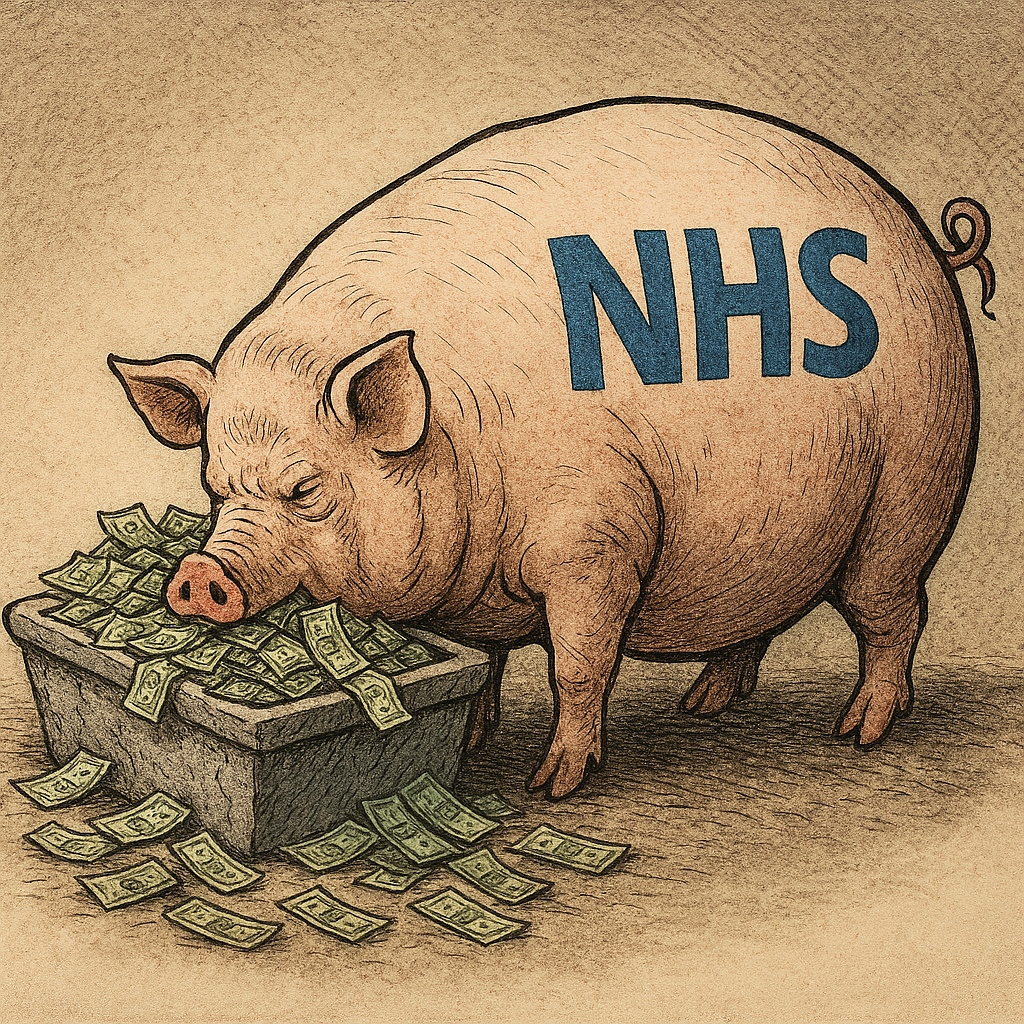
The NHS Pig
The National Health Service (NHS) became the system we recognise today on 5 July 1948, when it was officially established across the United Kingdom. This launch created, for the first time, a universal healthcare system — one funded through general taxation, free at the point of use and available to every resident, regardless of income. Britain was the first Western country to offer this model of healthcare to its entire population.
I refer to the system as the NHS Pig because it has become a creature that grows larger every year, consuming ever‑greater quantities of public money without becoming leaner, healthier or more efficient. Like a pig at a trough, it is fed continuously — more taxes, more borrowing, more political promises — yet it never reaches a point of sufficiency. The more it is given, the more it demands. And because the trough is filled collectively and the feeding happens out of sight, the public never sees the true scale of what is being consumed.
Today it has grown into an entity that employs circa 1.9 million people directly or indirectly. It is now the largest civilian employer in Europe, and the 5th largest employer in the world. It is larger than Amazon globally, larger than China National Petroleum, and larger than Indian Railways which provides a national service to 1.4 billion people. Only China’s People’s Liberation Army, the United States Armed Forces, the Indian Armed Forces and Walmart have more employees.
Politicians routinely present the NHS as a £150 billion service — a number repeated so often that it has become a kind of national shorthand. But this headline figure is only the operating budget. It excludes the structural costs, the hidden liabilities, and the long‑term commitments that future taxpayers are already locked into. When these are included, the picture changes dramatically.
According to the Office for National Statistics (ONS), the cost to the UK’s taxpayer in 2024 was circa £317 billion — a cost of approximately £11,200 per household, or £9,100 per taxpayer. However, this £317 billion represents only the day‑to‑day operating cost of the system. It excludes the structural liabilities that sit beneath the NHS like bedrock.
These include the annual capital bill for buildings, equipment and infrastructure; the multibillion‑pound maintenance backlog across a decaying estate; the persistent deficits carried by NHS trusts; and, most significantly, the NHS’s vast unfunded pension obligations — one of the largest tax‑funded public‑sector pension liabilities in the world.
The NHS Pension Scheme alone carries future obligations estimated in the hundreds of billions, and when these are annualised, they add an additional burden of roughly £19 billion per year on top of the operating cost. Once capital spending, trust deficits, estate decay and pension liabilities are included, the true yearly cost of the UK’s healthcare system rises from £317 billion to approximately £357 billion — a figure that reflects not just what the NHS spends today, but what it has already committed every future taxpayer to fund. This lifts the real burden to circa £12,600 per household, or £10,200 per taxpayer, every single year.
To understand the true scale of the NHS’s long‑term obligations, it is important to recognise the size of the liabilities attached to each doctor. A full‑career consultant can retire with a pension entitlement worth the equivalent of £2–3 million, while even a non‑consultant doctor can retire with an entitlement valued at over £1 million.
These are not cash balances, but taxpayer‑funded promises that must be honoured for decades. When multiplied across the medical workforce, the pension liabilities attached to doctors alone run into the hundreds of billions. Every doctor who completes a full NHS career carries a long‑term fiscal commitment far larger than their salary, and these obligations form a major component of the NHS’s overall financial burden.
There is no doubt: when it comes to pensions, doctors are effectively the Premier League footballers of the NHS. Unlike the private sector — where only a tiny minority ever approach the Lifetime Allowance — NHS doctors routinely breach it, not because they are accumulating vast investment pots, but because their taxpayer‑funded, inflation‑linked defined‑benefit pensions carry actuarial values of £1–3 million. How many private‑sector workers ever reach a pension value of £1–3 million? Almost none. Yet in the NHS, this is routine — and entirely taxpayer‑funded.
But cost is only one element of the NHS conundrum. Since its inception, the NHS has grown its footprint and service offering far beyond anything imagined in 1948. What began as a general‑purpose healthcare system has evolved into a universal, all‑encompassing service providing care for hundreds of disorders — including many that would once have been considered part of the normal spectrum of human conditions, such as stress, anxiety, low mood, loneliness and a wide range of lifestyle‑driven ailments.
Many of these experiences are not new at all; they are as old as humanity itself. Stress, worry, sadness, loneliness, restlessness, frustration and insecurity have been part of the human condition for millennia. What has changed is not their existence, but the decision to classify, diagnose and medicalise them. Experiences that previous generations understood as normal fluctuations of life are now routinely framed as clinical disorders requiring intervention, treatment or welfare support. This shift has expanded the NHS’s remit far beyond illness and injury, transforming it into a system expected to manage the full emotional and psychological spectrum of modern living.
This expansion of human needs, wants and expectations has accelerated costs dramatically, transforming the NHS from a safety‑net service into a catch‑all system expected to absorb every physical, emotional and social pressure of modern life. Advances in detection, diagnosis and preventative screening have further exacerbated the issue. Aided by the global pharmaceutical industry, the NHS now identifies — and medicalises — a new ailment with remarkable regularity, widening its remit and deepening its financial exposure year after year.
The introduction and expansion of welfare schemes linked to health conditions has intensified the problem further. As the list of recognised ailments grows, so too does the welfare bill. The system has evolved in such a way that the threshold for being classified as unwell, impaired or unable to work has steadily lowered, creating incentives that pull more people out of the productive economy and into long‑term dependency. This is not a criticism of individuals, but of a framework that increasingly rewards withdrawal rather than participation, and that treats a widening range of human difficulties as permanent incapacities.
There are environmental consequences too. Pharmaceutical companies manufacture vast quantities of drugs to service this ever‑expanding demand. As the number of diagnosed conditions rises, so does the production, transportation and packaging required to supply them — increasing waste, emissions and resource consumption. A system originally designed to treat illness now fuels a cycle of medicalisation, consumption and environmental strain.
Whilst the current financial trajectory appears unsustainable, the population’s appetite for medical care remains insatiable. So where do we go from here. Which brings us to the uncomfortable but essential question: who actually cares? After all, it’s “free”, isn’t it. The reality is the opposite — it is not free, and the costs are escalating far beyond public awareness. Each year the UK’s national debt rises, deficits widen, and the true financial burden of the NHS is quietly absorbed into long‑term liabilities that future taxpayers will be forced to carry. Politicians from all parties prefer to talk about waiting lists, staffing levels and headline budgets, yet consistently avoid the deeper question of how the system is funded and whether the model itself remains viable.
Compounding this, the population has no meaningful way of knowing whether it is receiving value for money. There is no real measure of customer satisfaction, no competitive benchmark, no alternative provider to compare against. The NHS holds a monopoly on healthcare in the UK, shielded from competition by design. And it is this absence of competitive pressure that lies at the core of the problem. Without competition, there is no incentive to control costs, no requirement to innovate, no pressure to improve service levels, and no consequence for inefficiency. The public — its captive customer base — will pay regardless of how well or poorly it performs.
A modern healthcare system cannot function indefinitely as an ever‑expanding trough of collected taxes. Without competition, without price signals, and without individual choice, the NHS has become a system where demand is infinite, costs are invisible, and responsibility is diluted across the entire population. The result is predictable: spiralling expenditure, rising expectations, and no mechanism to moderate behaviour or improve performance.
This is why competition and personal choice are essential. In a competitive environment, individuals are not passive recipients of whatever the system provides; they become active participants in their own care. Take the example of someone needing a hip replacement. Under the current NHS monopoly, they have no idea what the procedure costs are, no ability to compare providers, and no freedom to choose based on quality, speed or value. They are placed on a waiting list and told to wait their turn — whether that is weeks, months or years — with no transparency and no alternatives.
In a system with open commercial competition, the experience would be entirely different. The individual could compare hospitals, clinics and providers. They could see the real cost of the procedure, examine customer reviews, compare waiting times, and choose the option that best suits their needs. Providers would be forced to compete on quality, efficiency, service levels and outcomes, because customers would be free to take their business elsewhere. Competition would drive innovation, reduce waste, and expose inefficiency in a way that a protected monopoly never can.
A pay‑as‑you‑use model — supported by savings, insurance, co‑payments or targeted assistance — reconnects individuals with the true cost of their care. It introduces a sense of ownership and responsibility that is entirely absent from the current system. When people understand the cost of a service, they use it more thoughtfully. Essential treatments are prioritised. Non‑essential elements — those an individual is unwilling to fund — are removed. Every pound spent is allocated with purpose. When providers must earn their custom, they raise their standards. And when choice is restored, the entire system becomes more efficient, more transparent, more accountable and more sustainable.
Crucially, such a model would take the UK’s healthcare system out of the hands of politicians and the unions. It could no longer be used as a tool to gain votes, nor as a stage for empty promises about “record funding” or “saving the NHS” every election cycle. Not only would it prevent political parties from weaponising healthcare, it would also reduce the unions’ ability to secure political influence. It would stop them from using the system as a bargaining chip in industrial disputes, from protecting inefficiency, and from resisting the structural reform the service desperately needs.
It would also reduce the unions’ access to tax‑funded membership fees and weaken their ability to influence wider political outcomes. The current NHS structure gives unions enormous leverage: millions of publicly funded workers, guaranteed membership pipelines, and the ability to threaten disruption in a system the public is emotionally attached to. This creates a political feedback loop where unions shape policy, resist reform, and exert pressure on governments who fear electoral consequences. A competitive, choice‑driven, pay‑as‑you‑use model breaks that loop. It reduces the size of the publicly funded workforce, removes automatic membership flows, and limits the unions’ ability to use the NHS as a political weapon.
A system built on transparency, competition and individual choice cannot be manipulated in this way. It is governed by outcomes, not slogans. By service levels, not soundbites. And by the needs of the individual, not the ambitions of the political class or the interests of organised labour.
Just as competition from low‑cost airlines redefined air travel — lowering prices, raising standards and forcing legacy carriers to improve — a pay‑as‑you‑use model would transform healthcare in the UK. It would introduce choice, discipline and innovation into a system that has been insulated from competition for decades. The same market forces that made flying accessible to ordinary families would make healthcare more responsive, more efficient and more accountable.
The alternative is the model we have now: a single, centralised, tax‑funded monopoly with no competitive pressure, no price signals, no customer choice and no natural limit on demand. A system where costs rise automatically, expectations expand endlessly, and the public is shielded from the financial consequences — until the bill arrives in the form of higher taxes, deeper deficits and mounting national debt. Competition is not a threat to healthcare, it is the mechanism that disciplines it. Choice is not a luxury, it is the foundation of accountability. And pay‑as‑you‑use is not a punishment, it is the only way to reconnect individuals with the reality of what healthcare costs.
Conclusion: Responsibility, Sustainability & Consequence
Ultimately, no healthcare system — no matter how well‑funded or well‑intentioned — can survive if it removes all personal responsibility from the individual and all financial discipline from the system. A model built on unlimited demand, invisible costs and collective payment will always drift towards unsustainability. The NHS is not failing because people are bad, or because staff are uncommitted, but because the structure itself encourages overuse, inefficiency and dependency. When something feels free, it will be consumed without limit. When no one sees the bill, no one questions the cost. And when responsibility is diluted across millions, it effectively disappears.
Economic sustainability demands a different approach. A system must have boundaries, incentives and consequences. It must encourage individuals to make informed choices, to understand the cost of their care, and to use services proportionately. It must reward efficiency, not protect inefficiency. It must allow competition to expose waste and drive improvement. And it must reconnect people with the reality that healthcare, like every other essential service, has a price — a price that someone must pay.
Environmental sustainability adds a further dimension. A system that continually expands its definition of illness, increases its consumption of pharmaceuticals, and medicalises ever‑broader aspects of human life inevitably increases its environmental footprint. More diagnoses mean more drugs, more packaging, more transport, more waste and more emissions. A healthcare model that encourages limitless consumption is not only economically unsustainable, but environmentally damaging. Sustainability requires restraint, responsibility and a clear understanding of what healthcare is for — and what it is not.
The conclusion is unavoidable: a tax‑funded monopoly with infinite demand and no personal responsibility cannot endure. If the UK wishes to preserve universal access to healthcare, it must rethink the model. It must introduce competition, restore individual choice, reconnect people with cost, and place responsibility back at the centre of the system. Without these changes, the NHS will continue on its current trajectory — expanding its remit, consuming ever‑greater resources, and placing an unsustainable burden on the economy, the environment and future generations.
Unless we change course, the NHS Pig will keep eating, the trough will keep emptying, and the nation will be left wondering how it ever mistook limitless consumption for sustainable care.
See CHOICE GB – Healthcare


2 Responses
I highly interesting read and well written. By demonstrating how the real world looks and showing how the NHS has a huge demand on the tax payer feels like we have been hidden under the covers for far too long. We have become such a peaceful society that we plod along all day long accepting everything we are told . Keep them coming Steve.
Thanks Col, hope you enjoyed the read. Steve