Steven Murphy / Earthism / The Earth Tax
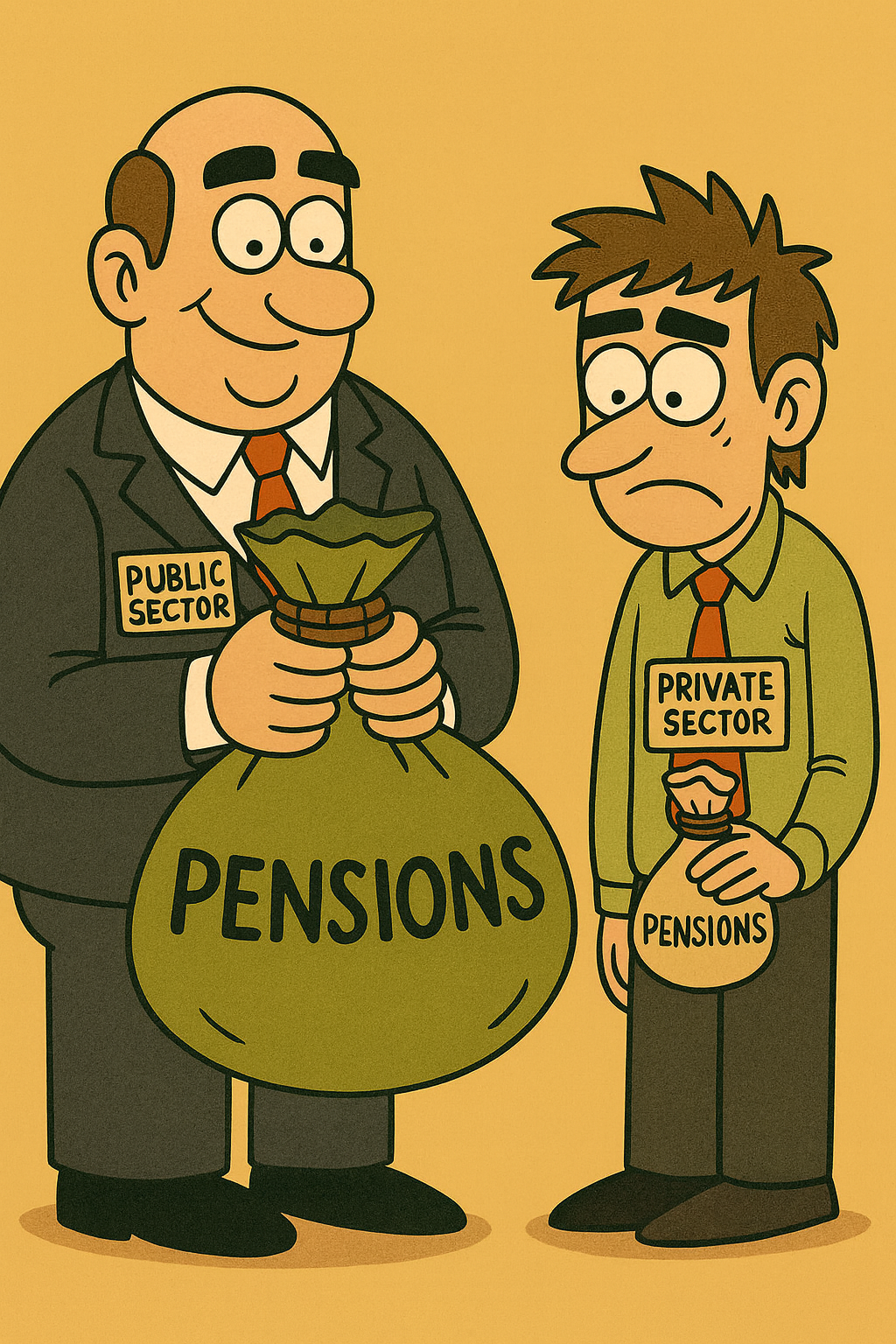
The Great Pension Divide
Britain likes to pretend that we are all treated equally, that equality is a foundation of our society. But when you start speaking to ordinary people, you quickly realise something uncomfortable: most of the population has no idea about the pension divide and how the pension system actually works. And that ignorance isn’t accidental, it’s structural, convenient and it keeps the divide hidden.
So before we go any further, we need absolute clarity about the three primary pension systems operating in Britain today — because they are not the same, they do not deliver the same outcomes, and they are not funded in the same way.
The State Pension (NOT what this essay is about)
- A flat‑rate payment from the government (Taxpayer), paid to everyone who qualifies.
It is not the source of the inequality we’re discussing, so far so good.
Private‑Sector Workplace Pensions (Defined Contribution)
This is the system used by most working people.
- Employer contributions: 3%–8%
- Entirely funded by industry — money must actually exist
- Exposed to stock and money markets
- There are no guarantees
- There is no taxpayer subsidy or enhancement
There are different variations on this for the self-employed, but ultimately for people working in this sector their retirement depends on how well their investments perform, the worker carries all the risk.
Public‑Sector Workplace Pensions (Defined Benefit)
This is the system used by tax‑funded workers: NHS, teachers, civil service, police, fire, local government.
- Employer contributions: 20%–30%
- Guaranteed, inflation‑linked, legally protected
- Backed by the taxpayer
- Supported by £1.4 trillion in unfunded liabilities
This is the system that creates the divide.
Who Pays For What And Why It Matters
Most people think pensions are simple, they think everyone pays in, everyone gets something out, and the system is basically fair. But that’s not how it works. To understand the divide, you need to understand who pays the wages, who pays the pension contributions, and who pays the gap. And once you see it clearly, the whole system becomes impossible to defend.
Private‑Sector Workers
In this sector, private business generates revenue and profits and pays the employee’s wages and pension contributions, the employee also makes a pension contribution from their salary. The primary pension type is what is known as Defined Contribution (DC), it offers no guarantees, it has no inflation protection and there is no involvement from the taxpayer.
Public‑Sector Workers
In this sector, the Government collects taxes and pays the employee’s wages and pension contributions, the employee also makes a pension contribution from their salary which has derived from taxation. The primary pension type is what is known as Defined Benefit (DB) Contribution, it is guaranteed, inflation-linked and is fully funded by the taxpayer.
The Hidden Public Sector
- NGOs, QUANGOs, Charities, Universities, Arms‑Length Bodies
These organisations are not technically government departments, but their income comes from:
- government grants
- public contracts
- statutory funding
- taxpayer‑backed subsidies
The simple truth is that if your wages come from taxpayers, your pension is a public‑sector pension — even if your organisation pretends to be “independent”.
The Inequality Reality
On average private‑sector employers contributions are around 3%–8%, for public sector workers whose contributions are derived from taxation and allocated via the Government it is between 20%–30%. The public sector receives four to six times the employer contribution of the private sector. This is not a gap, it is a chasm.
Tax-funded workers don’t have to worry about the markets, they don’t have to worry about inflation, they’ve got it all covered. In addition to this, they sit in a bubble protected by politicians from the real world. If the economy is in recession, it doesn’t matter, if the markets have crashed, it doesn’t matter, if inflation sky rockets, it doesn’t matter. They have no exposure, they have no risk. They have a guaranteed level of income for life, that is inflation-proof and is backed by the rest of the tax paying population.
Compare that to the non-tax funded workers, to whom the politicians offer no protection. These workers are left to defend for themselves, left to live in a volatile world of real uncertainty. Totally exposed to every risk possible, no back-up, no guarantees. The irony here is that it is the non-tax funded workers and industry that generate the taxes, that generate the populations wealth. It is a fact, that without the private sector to fund it via taxation, there would be no public sector, it wouldn’t exist.
How Public‑Sector Pensions Are Really Funded
How pensions — and especially public‑sector pensions — are funded is one of the most misunderstood areas in British society. So let’s clear this up immediately, the UK does not have a pension investment pot. There is no fund, there is no pool of assets growing in the background. Public‑sector pensions are paid directly from taxation, money comes in from taxpayers, and it goes straight back out to pensioners. It is a collection‑and‑distribution system, not an investment system.
The Numbers, each year, UK taxpayers contribute roughly £40 billion into public‑sector pension schemes. But the amount that must be paid out to retired public‑sector workers is around £90–£100 billion. That leaves a shortfall — a gap — of £50–£60 billion every single year.
So who pays the gap?, you do. The Reality is that taxpayers don’t just fund the contributions going in today.
Taxpayers also fund:
- the shortfalls
- the unfunded liabilities
- the inflation‑linked guarantees
- the lifetime promises already made
Taxpayers today must fund it, taxpayers tomorrow will have to fund it. Because these pensions are legally guaranteed — and the only source of money to honour those guarantees is taxation of the wider population. There is no opt‑out, there is no investment pot to draw from, there is no alternative revenue stream.
If you live in the UK and pay tax, you are paying for these pensions — both the contributions and the shortfalls — whether you work in the public sector or not. So there it is, you have no say, no choice, another case of put up, shut up and pay up governance. If this wasn’t depressing enough, it doesn’t tell the full story. Worse is yet to come.
To‑date the government has promised £1.4 trillion in future public‑sector pensions. This is a real liability. It is legally binding and must be paid, and yet it is not included in the national debt figures. If a private company hid a liability like this, it would be illegal. When the state (Politicians) do it, it’s called “accounting convention”. But here’s the part the public never hears.
If we added the £1.4 trillion pension liability to the official national debt, the UK’s real debt would jump from roughly £2.7 trillion to over £4.1 trillion.
That means:
- the real national debt is over 50% higher than the government (Politicians) admits
- the real debt‑to‑GDP ratio is not ~100% — it is well over 150%
- the UK is carrying one of the largest hidden liabilities in the developed world
- every taxpayer is already on the hook for promises they never agreed to and cannot opt out of
This is not a theoretical number, it is not a projection, it is not a future risk.
It is a current, unavoidable, legally guaranteed obligation — and the only way it will ever be paid is through, higher taxes, more borrowing or both. The public‑sector pension liability is the single largest unacknowledged debt in the United Kingdom, it is bigger than the NHS budget, bigger than education, bigger than defence and bigger than every welfare programme combined.
And yet it is kept off the books — hidden from the public, hidden from debate, hidden from scrutiny. Yet we keep on adding to it.
The Nationalisation Trap
Every time Britain nationalises something — a rail line, a utility, a service — the cost to taxpayers increases immediately. Not because the service becomes more expensive to run, but because, nationalisation transfers the entire salary and pension burden to taxpayers.
As already discussed private‑sector wages and pensions are paid from revenue, public‑sector wages and pensions are paid from taxation. When something is nationalised, wages are aligned and rise to public‑sector levels. These wage increases are taxpayer‑funded, there is no commercial discipline, the cost is simply passed on without consultation or debate.
Additionally, nationalisation instantly moves workers into the public‑sector pension system — with all its guarantees, inflation protection, and unfunded liabilities. The Result is that nationalisation doesn’t just bring assets into public ownership. It brings higher wages, higher pension contributions, increased unfunded liabilities, lifetime guarantees and inflation‑linked commitments. All funded by taxpayers.
This is why nationalisation always increases taxes, which in turn increases the cost of living and the cost producing anything in Britain. We immediately become less competitive, we as a society carry a heavier tax and debt burden.
Levelling Down Is The Only Option
Britain cannot talk seriously about the cost of living, the cost of producing anything in this country, or the competitiveness of our economy without confronting the single largest hidden cost sitting inside the system:
- The cost of public‑sector salaries and pensions.
You cannot make Britain competitive while one half of the workforce is carrying the full weight of global markets and the other half is protected from them. You cannot lower taxes while the state is sitting on a £1.4 trillion liability that isn’t even counted in the national debt.
You cannot reduce business costs, while private employers are forced to compete with a pension system they do not benefit from, but must still fund through taxation. You cannot fix inflation while the state is pumping tens of billions a year into unfunded pension promises. You cannot talk about fairness while one group receives four to six times the pension support of another.
We cannot level up, the only honest path is to level down. Not because we want to, but because the maths leaves no alternative. Equalising private sector pensions to current public sector pension levels, would cost the UK taxpayer between £180 – £250 billion extra per year. This equates to around £4,800–£6,700 per taxpayer, no country on earth can absorb that.
So the choice is simple, continue pretending the system is fair. Continue hiding the £1.4 trillion liability, continue pushing the burden onto future taxpayers, continue widening the divide between public and private Britain. Or confront the truth, the pension inequality is the root cost driver in the British economy. Until we address it, nothing else will change, not productivity, not competitiveness, not living standards.
There will be no real growth, no real equality, no real fairness, just higher taxes. This is the structural imbalance at the heart of the nation. And until Britain has the courage to level down the pension system, the country will remain trapped in a cycle of rising costs, falling competitiveness, and deepening inequality.
See CHOICE GB – Economy