The King In The North Is Coming – Will He Steady or Sink The Ship?.
Man The Lifeboats!!
As I sit here writing this, I keep finding myself drifting between the keyboard and the news, almost shaking my head at what I’m watching. It’s one of those moments where you’re half‑typing, half‑thinking, and you realise your mouth is slightly open in that quiet “what on earth am I looking at?” way. I’m watching a Prime Minister under attack from his own team, from the public, from commentators who can barely keep up with the pace of the criticism.
I just can’t help asking myself the obvious question: Why did we ever think that someone with little or no experience in the real world would make a great leader? This isn’t personal. It’s structural. We ended up with an individual whose entire career has been built around human rights campaigns, globalist thinking, and the softer, more theoretical side of politics. Someone who has never worked in the income‑generating part of the economy. Someone who has never had to meet payroll, manage cash flow, or survive the pressures that define the real economy. So it shouldn’t surprise me — or anyone — that the cracks are showing. But it does. Because the speed of it, the scale of it, the sheer fragility of it all… it’s hard not to sit here and think: How did we not see this coming?
And then, almost unbelievably, the conversation shifts. Instead of asking how we ended up with a leader so unprepared for the real world, the Socialist left starts whispering about bringing in the “King In The North” Andy Burnham to “steady the ship” or “save the day.” And that’s the moment where I lean back in my chair, stare at the screen, and genuinely laugh under my breath. Save the day? Andy Burnham? How?
Because here’s the truth — and again, this isn’t personal, it’s structural. Andy Burnham has spent his entire adult life inside the tax‑funded side of the economy: parliamentary researcher, special adviser, MP, minister, shadow minister and mayor. Every salary, every pension contribution, every staff budget — all of it funded by taxation. He has never worked in the income‑generating part of the UK economy. Not once. He has never had to generate revenue, meet payroll, manage cash flow, face insolvency, or build something that must pay for itself.
His world has always been the opposite: a world where the income arrives automatically, through taxation, regardless of performance or productivity. So of course he sees the economy differently. Of course he sees the private sector as something to be taxed rather than understood or nurtured. Of course he sees markets as something that should “come to heel.” It’s not a personal flaw. It’s simply the worldview of someone who has only ever lived on one side of the ledger. The tax funded side.
And as I sit here thinking about all this, the picture becomes even clearer. He markets himself as this working‑class lad, the man of the people, the bloke who “gets it” because he supposedly comes from the same world as the scaffolders, the brickies, the offshore workers, the lorry drivers, the warehouse pickers — the people who actually keep the country running. But the reality doesn’t show that at all. He isn’t their poster boy. He’s the poster boy for the tax‑funded union world, the comfortable public‑sector bubble where the income is guaranteed, the risks are minimal, and the consequences never land on your own doorstep.
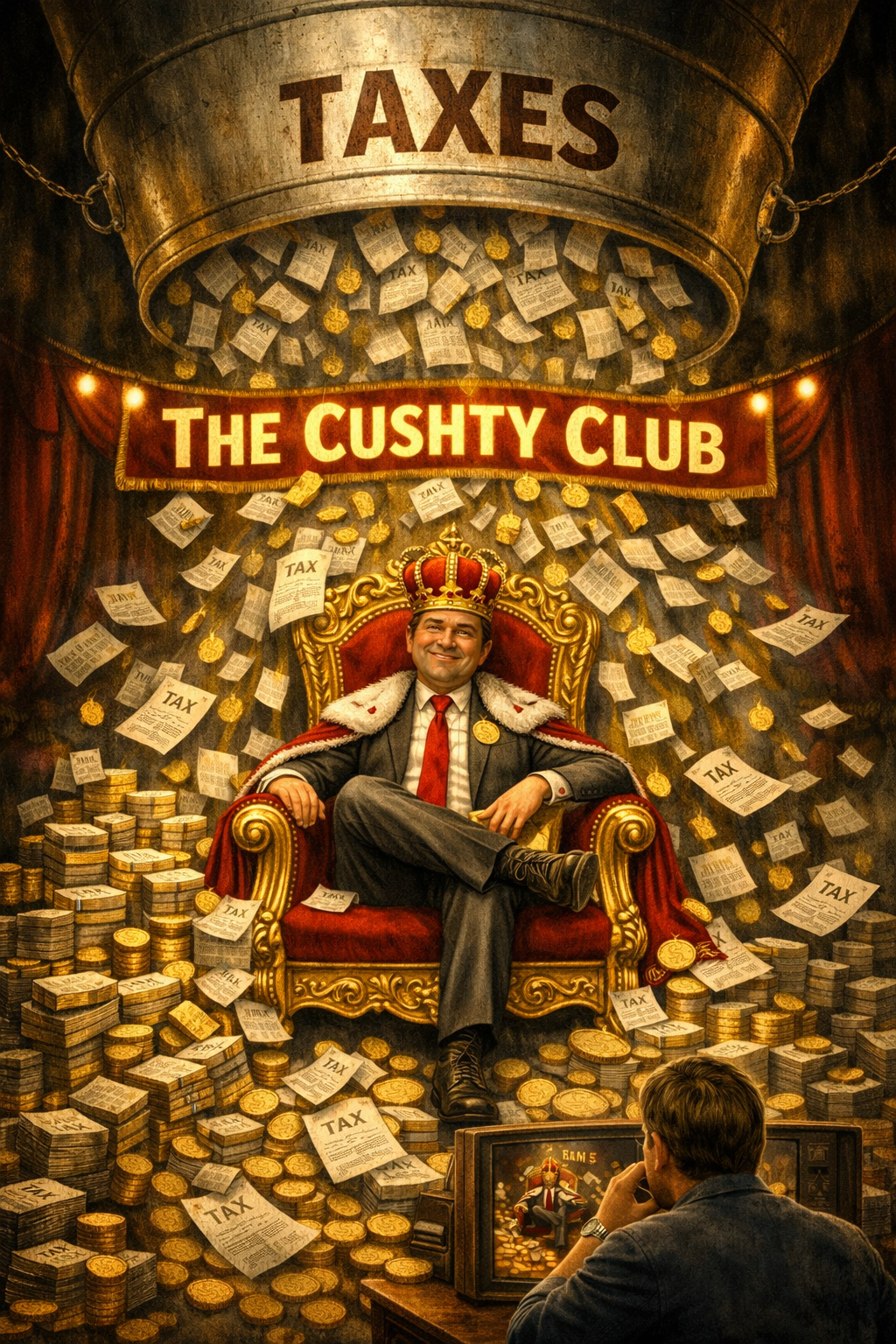
He’s a member of the cushty club — the ice‑cream‑every‑day club — because in his world nothing has to be earned. It just has to be collected from someone else and spent on the niceties of life. It’s a strange kind of performance: the working‑class costume is there, the accent is there, the story is there, but the lived reality is a sheltered tax‑funded cocoon from start to finish. And yet here we are, watching a Prime Minister with no real‑world experience struggle under the weight of the job… and the solution being floated is to replace him with someone who has even less connection to the income‑generating part of the country. It’s surreal. It’s almost comical. And yet it’s happening in real time, the “Golden Age for the Tax‑Funded World”.
I sit here thinking this through, I can already picture how certain groups in our society will react if Burnham is pushed forward. The tax‑funded union world will love it. This could be the golden age for tax‑funded workers — the moment they’ve been waiting for. You can almost see it: the pay rises, the pension boosts, the shorter working weeks, the endless demands dressed up as “fairness” and “rights.” They’ll gorge on collected taxes like hyenas on a carcass, tearing through the public purse with the confidence of people who know the bill will never land on their own doorstep.
Every day will feel golden for them. A celebration. A feast. But here’s the thing I keep coming back to as I write this: golden ages always end. And the endings are never gentle. They’re brutal. Because eventually the money runs out. Eventually the markets stop playing along. Eventually the people who actually generate the income — the private sector, the workers, the businesses, the taxpayers — hit the wall and say “enough.” And when that moment comes, the very same political class that was hoisted up as the hero is suddenly thrown out like a squatter. No ceremony. No gratitude. Just a sharp reminder that reality always arrives, even if it’s late.
And then there’s the wider political problem. The Labour Party is behaving as though it has been handed a historic, overwhelming mandate. But in the general election it only won 35 out of every 100 votes cast, the reality is that 65 out of every 100 voters didn’t vote for them or their policies. So what you see is not a landslide of public enthusiasm. It is not a national endorsement of a radical programme. It is not a sweeping mandate for structural transformation. It is the mechanical outcome of a flawed electoral system. First Past the Post converts minority support into overwhelming parliamentary power.
It’s a system that wastes millions of votes. It punishes smaller parties and rewards geographic concentration. It creates majorities that do not reflect the wants and needs of a country. Labour’s huge majority isn’t the result of brilliance. It’s the result of mathematics. A parliamentary majority is not the same as a public mandate. But the system treats them as identical. And the public has no mechanism to stop it. No recall. No second vote. No requirement for a fresh mandate. Just put up, shut up, and pay up.
So here we are, another extreme left Labour government. We’ve seen this socialist playbook before. It’s not new. It’s not innovative. It’s not some fresh, modern vision. It’s the same old tune played by a different piano player. The names change. The slogans change. The branding gets updated. But the melody is identical. Higher taxes. Higher tax‑funded spending. Lower national income generated. Larger deficits. Higher debts. And an even bigger problem to solve further down the line.
It always starts the same way — with big promises, moral language, and the idea that the state can fix everything if only it had more money. And it always ends the same way — with the state running out of money, the markets losing patience, and the public left to pick up the pieces. Golden ages don’t fade out softly. They end with a jolt.
As I’m writing this final section, I can’t shake the thought that if all of this comes to pass — and I genuinely hope it doesn’t — then we will look back and say the British people had well and truly lost the plot. Not in a dramatic collapse‑of‑civilisation way, but in that quiet, baffling way where a society drifts into decisions that make no sense when you step back and look at them.
And by the time the consequences arrive — because they always do — the perpetrators will have ghosted into the mist of time. They always do. They’ll be cushioned from any kind of accountability, sitting comfortably on their tax‑funded pensions, writing memoirs about “lessons learned” while the rest of the country deals with the fallout. That’s the part that stings the most as I write this. The people who make the decisions never pay the price. The people who cheer the loudest never carry the burden. And the people who warned about it are left standing in the rubble saying, “Well, what did you expect?”
History has a way of being brutally honest long after the moment has passed. It strips away the slogans and the sentiment and leaves behind the simple truth of what happened. History will show that it did — because no society on earth has ever taxed itself into prosperity. Some have tried, and every attempt has ended in disaster. Think Venezuela. Think Argentina. The simple fact is that trying to tax yourself into prosperity is like sitting on your hands and trying to lift yourself up. It’s impossible.
And as for the King In The North, will he steady the ship or sink it?. I know where my money is, man the life boats.

2 Responses
Some very good points and interesting ready . I like some of the analogies you use to those disguised as working class . All very good when sitting in a high tower away from reality
Thanks for taking the time to read it, hope you got something from it.