Steven Murphy / Earthism / Earth Tax
The Predatory Imperative: Securing Resources in an Era of Scarcity
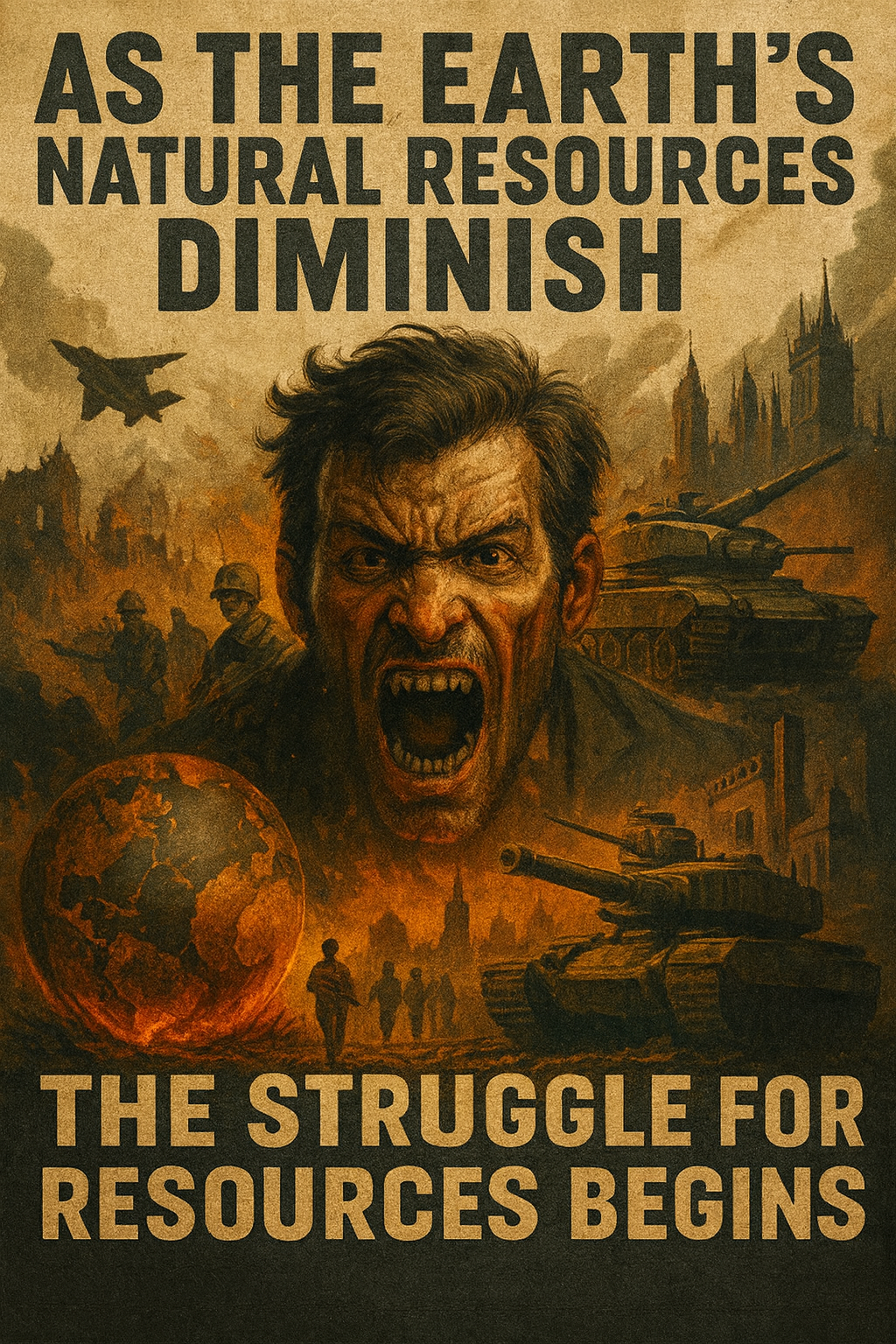
Beneath the veneer of civility lies an instinctive savagery. As natural resources diminish, societies will compete for survival, and those that are economically, financially, or militarily weak will lose. History makes this clear: when pressure rises, societies turn on each other. The question is not if this will happen again, but when.
We saw early hints during COVID, when the EU considered blocking vaccine exports and UK officials reportedly explored “all options.” Boris Johnson later wrote that he even contemplated deploying troops. It didn’t happen — but it revealed how quickly cooperation collapses when scarcity bites.
More recently, the Trump administration has, perhaps unintentionally, accelerated this dynamic. Talk of absorbing Canada or Greenland may sound fantastical, but dismissing it outright would be naïve. Look at Ukraine: while thousands die, the United States has leveraged the crisis to secure access to Ukrainian natural resources. As President Trump bluntly stated, “They don’t have the cards”.
The US invasion of Venezuela further highlights the global risks, discussions about absorbing neighbouring territories, expanding influence, or reshaping borders — once unthinkable — now circulate openly in political discourse. The underlying pattern is clear: states that cannot defend their assets, resources, and territory risk becoming targets in a more competitive world. These are early moves on a much larger geopolitical chessboard, but the same logic applies in the Indo‑Pacific.
China’s ambitions toward Taiwan, combined with the rapid expansion of domestic microchip manufacturing in the United States, raise questions about how future crises might unfold once strategic dependencies shift. Even resource‑rich, sparsely populated nations such as Australia face long‑term strategic vulnerabilities in a world where population, proximity, and power projection matter more than sentiment.
What is clear is that societies unable to defend their assets will become prey. This reality demands a strategic reset for nations like the UK. Historical alliances and inherited strengths are no longer enough. Survival will depend on anticipating military, economic, and environmental threats before they materialise. Energy independence, technological innovation, and sustainable resource management are not luxuries — they are defensive necessities in a predatory world.
The UK must also reconsider its participation in outdated institutions such as NATO, which has become bloated with career bureaucrats drifting from conference to conference at taxpayer expense. Instead, we should reinforce alliances rooted in shared language, culture, and values, while forging new partnerships with societies that possess real economic and military strength. Now is not the time to invest in partners, who lack the will or capability to contribute meaningfully.
Alliances matter, but relying on them entirely would be reckless. The UK must retain the ability to act alone when required. As recently as 1982, we went to war to reclaim a territory seized in the South Atlantic. We prevailed — but the conflict exposed the fragility of our capabilities. Our forces were under‑equipped, our wartime supply chain sluggish, and the post‑war decades have only weakened us further. Budget cuts and shrinking personnel numbers raise a serious question: could we even repeat that operation today?
This leads to a blunt reality: why would other societies want us as a partner if we bring little military value? Even children forming teams in a playground don’t pick the weak. Nations behave no differently.
We do not know where the next global challenge will come from; conflict can erupt anywhere, at any time, without warning. The Russian invasion of Ukraine proved that instability can appear suddenly and irrationally. That is why the UK must act now. Promising to “increase defence spending in the future” is not a strategy — it is a delusion.
No serious nation signals to potential adversaries that it is currently weak but hopes to be stronger later. It is the geopolitical equivalent of saying, “We’re not quite ready — could you wait while we prepare?” and hoping that hostile societies respond with patience and goodwill. They won’t. Predators do not wait for their prey to become stronger. If we are not ready now, we are vulnerable now.
The UK must withdraw from non‑essential overseas commitments and concentrate resources on strengthening our own strategic assets and territories. We should expand our presence in the North Atlantic, the Arctic Circle, and the Southern Ocean around Antarctica. As new frontiers open, we must be positioned to stake our claim and defend it against any hostile society. As Earth’s resource warehouse empties, global relationships will inevitably strain. This is not warmongering — it is prudent preparation for the worst, while hoping for the best.
See CHOICE GB – UK Defence