Steven Murphy / Earthsim / Earth Tax / CHOICE GB
Global Stock Markets – QE’s Poster Child
There is something strange about watching markets break records day after day. Not exhilarating, not reassuring — something closer to disbelief. The numbers on the screen describe a world that doesn’t quite resemble the one we live in. The charts insist that prosperity is everywhere, that confidence is rising, that the future is bright. Yet the streets, the services, the wages, the energy bills, the political mood — none of it feels like a boom. The gap between the financial world and the physical one grows a little wider each week, and the wider it gets, the more determined the commentary becomes to pretend the two are still connected.
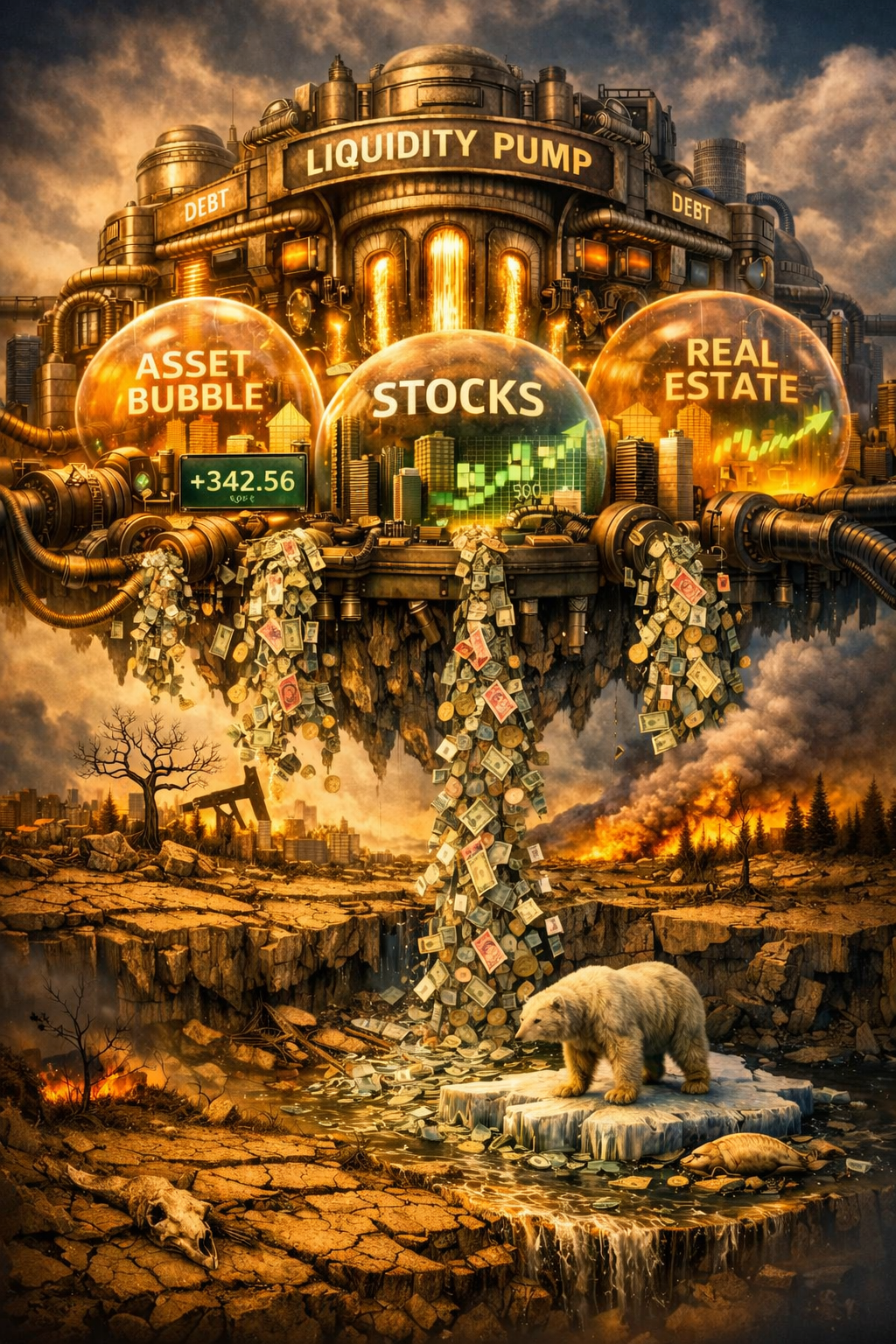
If you listen to the explanations, you’d think we were living through a renaissance. Strong earnings. Resilient consumers. AI‑driven productivity. A soft landing so soft it apparently defies gravity. But the stories feel thin, as if they were written after the fact to justify a line that keeps rising regardless of what is happening outside the financial system. Once you strip away the language, the mechanism becomes almost embarrassingly simple. The markets are rising because the financial system is still saturated with money that didn’t exist fifteen years ago. Money created electronically. Money injected directly into financial markets. Money that never passed through the real economy on its way in.
We call it liquidity because that sounds technical. We call it quantitative easing because that sounds scientific. But the plain version is easier to understand: new money was created, and it flowed into financial assets. When more money chases the same assets, prices rise. That is the entire story. It has nothing to do with a sudden surge in capability or productivity. It has everything to do with the scale of the financial intervention that has become normalised.
There was a time when wealth had a physical anchor. It came from land, labour, resources, or risk. It required time or effort or ingenuity. Today, wealth appears without any of those things. A central bank adjusts a rate. A balance sheet expands. A few keystrokes later, trillions of dollars exist that didn’t exist the day before. No factories built. No productivity gained. No innovation required. Just numbers added to a system that treats them as real. And because the money enters through financial markets rather than the real economy, it inflates the price of assets rather than the value of work. That is why markets can hit all‑time highs while living standards stagnate. It is why asset owners feel richer while everyone else feels squeezed. It is why the financial world floats upward while the physical world feels heavier every year.
Once you see the mechanism, the behaviour of the markets stops being mysterious. They rise because the system has been engineered to rise. They rise because liquidity suppresses risk. They rise because every wobble is met with intervention. They rise because the alternative — letting the system clear — is now considered unacceptable. We have built a financial environment where slowdowns are treated as errors, not signals. Where corrections are treated as crises. Where the natural pauses that once forced economies to reset are overridden by policy. The markets don’t reflect the world. They reflect the refusal to let the world interrupt the markets.
This creates a kind of financial euphoria — a high that feels good in the moment but has nothing to do with underlying health. Liquidity rises, asset prices rise, confidence rises, narratives rise, and eventually expectations rise beyond anything the real economy can deliver. It feels like prosperity, but it isn’t. It’s a sugar rush — a temporary elevation created by artificial inputs. And like any sugar rush, it comes with a cost.
Part of the current euphoria rests on a quiet assumption: that the world is running out of capacity. That demand is so strong, so relentless, so structurally elevated that the global economy must expand to keep up. That we need more factories, more production, more energy, more everything. It is the story behind the optimism, the valuations, the belief that the only direction left is upwards. But before 2020, the global economy wasn’t suffering from a shortage of supply. It was suffering from too much of it. Too many factories, too much capacity, too much globalised production, too many goods chasing too few buyers. Prices were flat because the world was efficient. Deflationary pressure existed because productivity had outpaced demand. This should have been a success story.
But for a system built on debt, deflation is dangerous. When prices fall, the value of money rises. When the value of money rises, the weight of debt increases. Your mortgage doesn’t shrink just because groceries get cheaper. A government’s debt doesn’t shrink because technology lowers production costs. A corporation’s liabilities don’t shrink because global supply chains become more efficient. Debt stays fixed. Everything else becomes cheaper. And that makes the debt heavier. Falling prices are good for people, but not for governments with enormous debt piles, banks whose balance sheets depend on rising asset values, corporations reliant on rolling over cheap borrowing, investors whose returns depend on inflation, or central banks tasked with keeping the whole structure upright. Deflation forces honesty, and the modern financial system cannot survive honesty.
So instead of allowing prices to fall — instead of letting the public benefit from efficiency, innovation, and oversupply — the system responded with the only tool it trusts: create more money. Not to help people. To protect the architecture. This is why the world that existed before 2020 — a world of oversupply, flat prices, and deflationary pressure — was treated not as a success, but as a problem. The system wasn’t worried about people struggling. It was worried about the debt struggling. And that fear is what drives the entire liquidity experiment we are living through today.
Once you understand why falling prices threaten a debt‑based system, the behaviour of central banks becomes easier to interpret. Inflation isn’t just tolerated — it is required. Rising prices make debts easier to carry. Rising asset values make balance sheets look healthier. Rising nominal GDP makes government debt appear smaller relative to the economy. Inflation is the lubricant that keeps the machinery turning. And once a system discovers that inflation can be engineered — that it can be summoned with liquidity, maintained with intervention, and revived with stimulus — it becomes very difficult to let go of the habit. Every slowdown was met with stimulus. Every wobble with reassurance. Every crisis with newly created money. Over time, the system learned that it didn’t need to clear excesses or correct imbalances. It just needed more liquidity.
Once liquidity becomes the primary tool, the financial system begins to mistake money creation for real demand. When central banks expand their balance sheets, asset prices rise. When asset prices rise, confidence rises. When confidence rises, spending rises. And when spending rises, it looks — on the surface — like genuine economic strength. But this is not demand rooted in wages, productivity, or real purchasing power. It is demand borrowed from the future, pulled forward by cheap money and inflated expectations. Liquidity doesn’t create new capability. It doesn’t create new resources. It doesn’t create new productive capacity. It creates the appearance of activity — a kind of financial motion that feels like growth but isn’t anchored to anything physical.
This is where the financial illusion spills into the physical world. When markets believe demand is permanent, they push for expansion. When policymakers believe growth is inevitable, they plan for more of it. When corporations believe consumption will rise forever, they scale production accordingly. But the planet doesn’t operate on liquidity. It doesn’t inflate because central banks want it to. It doesn’t expand because markets expect it to. It doesn’t grow because investors need it to. The biosphere has limits, and those limits do not move just because the S&P 500 does.
And here is the irony that almost never appears in financial commentary. Liquidity is always pushed into the system for the same reason: to save it from something. To cushion a shock, to prevent a correction, to smooth a downturn, to provide what policymakers like to call a “soft landing.” The language makes it sound gentle, almost responsible — as if the system is being protected for the benefit of everyone. But every soft landing for the financial system is a hard landing for the planet. Every manufactured solution, every human‑centred policy, pulls the natural world further into retreat.
Liquidity is exactly that — a manufactured solution, a human‑centred policy, a rescue designed to protect the system from consequence. But the consequence doesn’t disappear. It is transferred. The financial system gets the cushion. The planet gets the impact.
A soft landing for markets means more extraction, more production, more energy use, more emissions, more pressure on ecosystems that are already stretched. A soft landing for investors means a hard landing for the soil, the water, the atmosphere. A soft landing for asset prices means a hard landing for the species and systems that have no say in the matter. The financial system is treated as something fragile that must be protected at all costs. The planet is treated as something robust that will absorb whatever is thrown at it. But the truth is the opposite. The financial system is infinitely flexible — it can be rescued with a keystroke, revived with a policy announcement, inflated with a balance‑sheet expansion. The planet is rigid. It cannot be revived with liquidity. It cannot be stimulated with confidence. It cannot be rescued with a press conference.
And yet the entire architecture of modern economics is built on the assumption that the system must never be allowed to slow down. Every time it tries, liquidity is injected to keep it moving. Every time it signals exhaustion, stimulus is applied to push it further. Every time it attempts to correct, the correction is overridden. The system is kept aloft, and the cost is pushed downward — into the physical world that has no mechanism for escape. The markets celebrate rising numbers while the ecosystems that sustain us absorb the cost. The financial world floats upward while the natural world sinks beneath the weight of our expectations. The illusion grows while the foundation erodes. If we do not find the humility to lose today, the entire ecosystem — and future generations — will lose tomorrow.
That is the truth the markets cannot price in. That is the truth liquidity is designed to hide.
When you step back from the noise, the picture becomes uncomfortably clear. The markets are not rising because the world has suddenly become more capable or more productive. They are rising because the financial system has been engineered to rise — because it cannot tolerate the alternative. The euphoria we see today is not the expression of a world getting richer. It is the expression of a system that has forgotten how to slow down. We have mistaken the expansion of money for the expansion of value. We have mistaken the inflation of asset prices for the growth of prosperity. We have mistaken the suppression of risk for the presence of stability.
The charts will keep rising until they can’t. The euphoria will continue until it doesn’t. The illusion will hold until the real world asserts itself — as it always does, eventually. And when that moment comes, we will discover that the wealth we thought we had was never really wealth at all. It was a story we told ourselves, written in numbers that floated above the world, untethered from the reality that sustains us.
The markets are hitting all‑time highs. But the world is not getting richer. It is getting more inflated. And inflation — whether in prices, in assets, or in expectations — is not prosperity. It is the shadow of prosperity, stretched thin across a system that no longer remembers what real wealth looks like.