Steven Murphy | Founder, CHOICE GB
The King In The North Has Arrived – And Nothing Has Changed
This morning, Andy Burnham is the MP for Makerfield. He beat Reform UK’s Robert Kenyon by more than 9,000 votes. He will almost certainly challenge Keir Starmer for the Labour leadership within weeks. The prediction I made when I first wrote this piece has arrived. The King In The North is no longer coming. He is here.
And absolutely nothing has changed.
That is not cynicism. That is the result telling you exactly what it is if you are willing to read it honestly rather than through the lens of whoever you were already cheering for.
Burnham won in a seat specifically engineered for him. A sitting Labour MP resigned to clear the path. The constituency is Labour heartland. The circumstances were designed to produce this outcome. And he still only beat Reform by 9,000 votes in Wigan. That is not a landslide of national sentiment. That is not a country turning a corner. That is one tribe consolidating behind its man in a seat built for the purpose, while the other tribe consolidated behind theirs and made him work harder than anyone in his camp would like to admit.
The trenches did not move. The sandbags just got rearranged.
Left leaning voters consolidated behind Labour. Right leaning voters consolidated behind Reform. The Conservatives collapsed but their voters did not cross the ideological line — they stayed home or moved sideways. The smaller parties were squeezed to irrelevance by a system that has no room for nuance. Two tribes. Two trenches. Same ground. Different faces.
This by-election did not resolve the divide. It illustrated it.
And yet here we are, watching the commentary treat it as a moment of transformation. Watching the Labour left celebrate as though the country has spoken with one voice. Watching the political class do what it always does — take a result that confirms the existing stalemate and dress it up as a new chapter.
It is not a new chapter. It is the same chapter. With a different name at the top of the page.
I wrote the original version of this piece some months ago, when Andy Burnham as Labour leader was still a whisper rather than a headline. I am updating it today because everything I wrote has arrived — and because being right early is only useful if you say so.
As I sat writing it then, I kept finding myself drifting between the keyboard and the news, almost shaking my head at what I was watching. A Prime Minister under attack from his own team, from the public, from commentators who could barely keep up with the pace of the criticism. Over 97 of his own MPs calling for him to go. A government in open crisis less than two years into a parliamentary term that was supposed to deliver a decade of change.
And I just could not help asking the obvious question. Why did we ever think that someone with little or no experience in the real world would make a great leader?
This is not personal. It is structural. We ended up with an individual whose entire career has been built around human rights campaigns, globalist thinking, and the softer, more theoretical side of politics. Someone who has never worked in the income-generating part of the economy. Someone who has never had to meet payroll, manage cash flow, or survive the pressures that define the real economy. So it should not surprise anyone that the cracks appeared. But the speed of it, the scale of it, the sheer fragility of it — it is hard not to look at it and think: how did we not see this coming?
And then, almost unbelievably, the conversation shifted. Instead of asking how we ended up with a leader so unprepared for the real world, the socialist left started openly calling for the King In The North to steady the ship or save the day.
Save the day? Andy Burnham? How?
Because here is the truth — and again, this is not personal, it is structural. Andy Burnham has spent his entire adult life inside the tax-funded side of the economy. Parliamentary researcher. Special adviser. MP. Minister. Shadow minister. Mayor. Every salary, every pension contribution, every staff budget — all of it funded by taxation. He has never worked in the income-generating part of the UK economy. Not once. He has never had to generate revenue, meet payroll, manage cash flow, face insolvency, or build something that must pay for itself.
His world has always been the opposite. A world where the income arrives automatically, through taxation, regardless of performance or productivity. So of course he sees the economy differently. Of course he sees the private sector as something to be taxed rather than understood or nurtured. Of course he sees markets as something that should come to heel. It is not a personal flaw. It is simply the worldview of someone who has only ever lived on one side of the ledger. The tax-funded side.
He markets himself as this working-class lad, the man of the people, the bloke who gets it because he supposedly comes from the same world as the scaffolders, the brickies, the offshore workers, the lorry drivers, the warehouse pickers — the people who actually keep the country running.
But the reality does not show that at all.
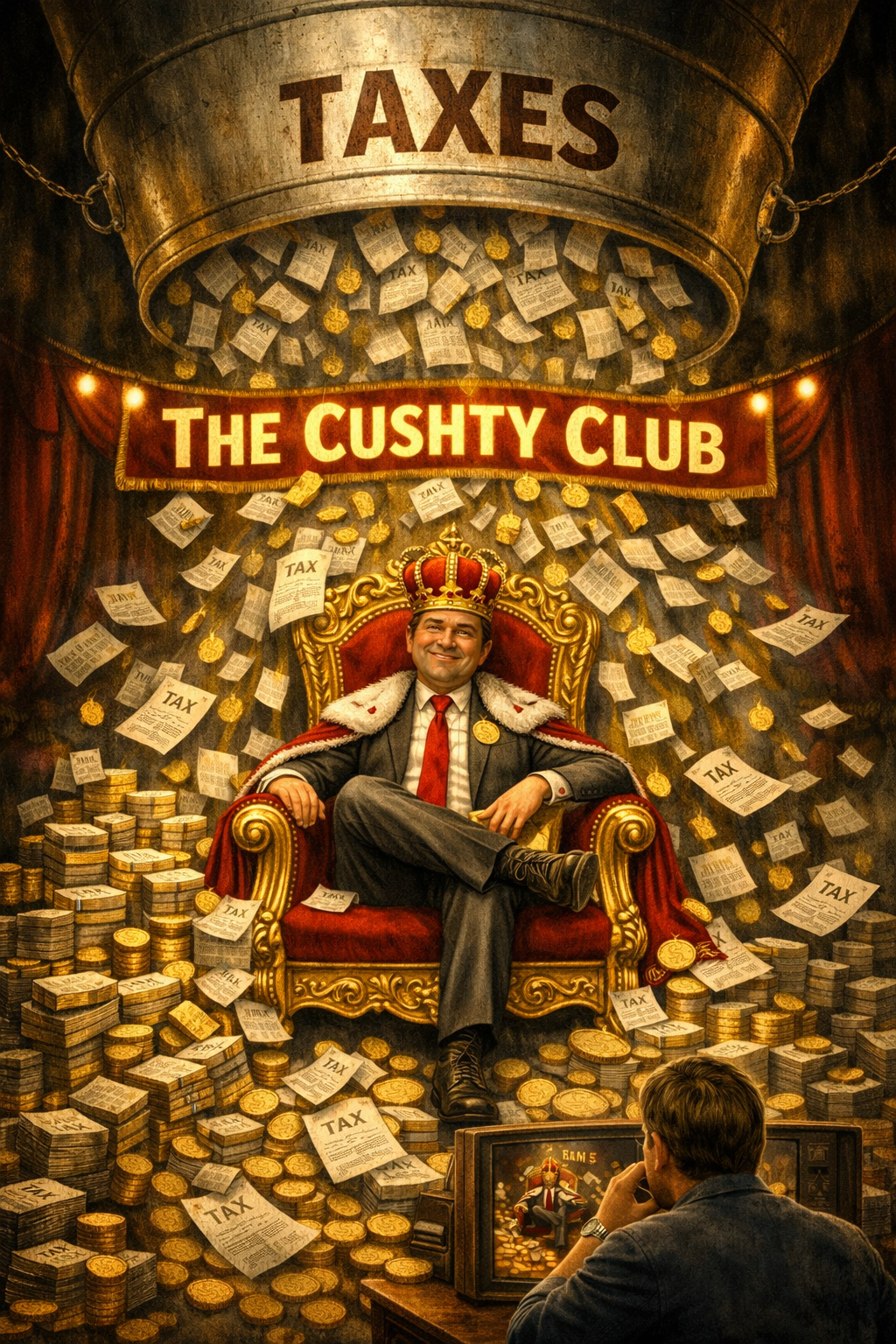
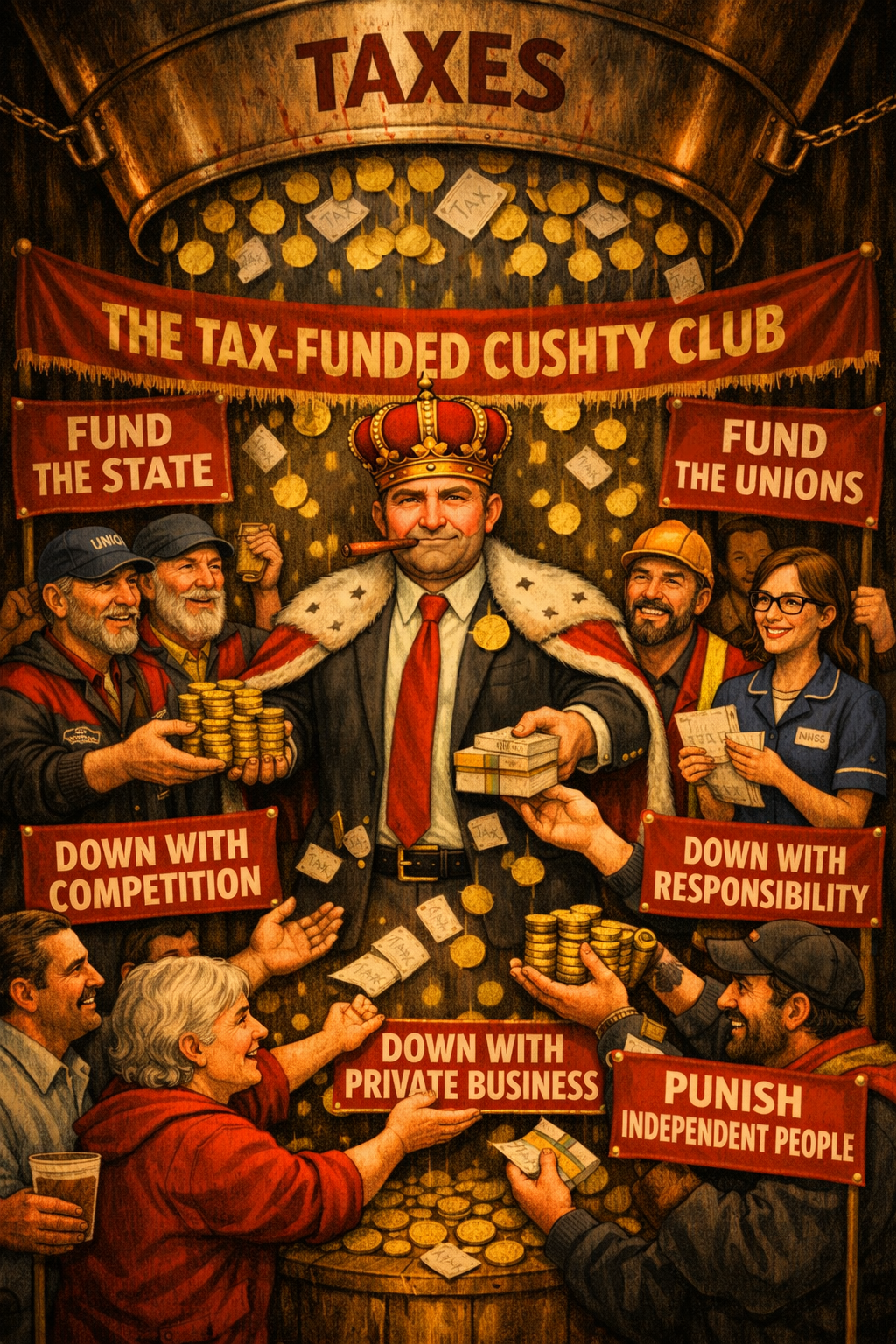
He is not their poster boy. He is the poster boy for the tax-funded union world, the comfortable public-sector bubble where the income is guaranteed, the risks are minimal, and the consequences never land on your own doorstep. He is a member of the cushty club — the ice-cream-every-day club — because in his world nothing has to be earned. It just has to be collected from someone else and spent on the priorities of the day.
It is a strange kind of performance. The working-class costume is there. The accent is there. The story is there. But the lived reality is a sheltered tax-funded cocoon from start to finish.
And yet here we are. Watching a Prime Minister with no real-world experience struggle under the weight of the job. And the solution is to replace him with someone who has even less connection to the income-generating part of the country.
It is surreal. It is almost comical. And it is happening in real time.
I can already picture what comes next as Burnham moves toward the leadership. The tax-funded union world will love it. This could be the golden age for tax-funded workers — the moment they have been waiting for. The pay rises. The pension boosts. The shorter working weeks. The endless demands dressed up as fairness and rights. They will gorge on collected taxes with the confidence of people who know the bill will never land on their own doorstep.
Every day will feel golden for them. A celebration. A feast.
But golden ages always end. And the endings are never gentle. They are brutal. Because eventually the money runs out. Eventually the markets stop playing along. Eventually the people who actually generate the income — the private sector, the workers, the businesses, the taxpayers — hit the wall and say enough.
And when that moment comes, the very same political class that was hoisted up as the hero is thrown out. No ceremony. No gratitude. Just a sharp reminder that reality always arrives, even if it is late.
There is a wider political problem that nobody in the Labour Party wants to say out loud.
Labour behaves as though it has been handed a historic, overwhelming mandate. But in the general election it only won 35 out of every 100 votes cast. The reality is that 65 out of every 100 voters did not vote for them or their policies. What you see is not a landslide of public enthusiasm. It is not a national endorsement of a radical programme. It is the mechanical outcome of a flawed electoral system. First Past the Post converts minority support into overwhelming parliamentary power.
It is a system that wastes millions of votes. It punishes smaller parties and rewards geographic concentration. It creates majorities that do not reflect the wants and needs of the country. Labour’s huge majority is not the result of brilliance. It is the result of mathematics.
A parliamentary majority is not the same as a public mandate. But the system treats them as identical. And the public has no mechanism to stop it. No recall. No second vote. No requirement for a fresh mandate. Just put up, shut up, and pay up.
Makerfield reinforced this exactly. Burnham won the seat. But look at the votes cast against him — for Reform, for every other candidate — and the story the victory speech will not mention is right there. The other half of the country is still there. Still angry. Still unconvinced. Still digging in.
So here we are. Another Labour government preparing to hand the keys to another career politician from the tax-funded side of the ledger.
We have seen this playbook before. It is not new. It is not innovative. It is not some fresh modern vision. It is the same old tune played by a different piano player. The names change. The slogans change. The branding gets updated. But the melody is identical.
Higher taxes. Higher tax-funded spending. Lower national income generated. Larger deficits. Higher debts. And an even bigger problem to solve further down the line.
It always starts the same way — with big promises, moral language, and the idea that the state can fix everything if only it had more money. And it always ends the same way — with the state running out of money, the markets losing patience, and the public left to pick up the pieces.
Golden ages do not fade out softly. They end with a jolt.
This morning Andy Burnham stands on the deck of a ship he has spent years positioning himself to captain. He will make promises. He will use the language of the north, of fairness, of the working people he claims to represent. He will talk about change. He will talk about a new kind of politics. And the half of the country that wanted him will cheer.
The other half will watch. And wait. And know that they have seen this before.
Because here is what nobody is saying this morning amid the celebrations and the analysis and the breathless commentary about what comes next.
The ship has a hole in it that no captain can fix by changing the crew. The hole is structural. It is fiscal. It is demographic. It is the product of decades of decisions made by people exactly like Andy Burnham — career politicians from the tax-funded world who have never had to balance a book that the market will not forgive.
The country is not divided because of bad leadership. It is divided because two completely incompatible worldviews are fighting for control of a system that can only ever hand total power to one of them. Burnham winning Makerfield did not bridge that divide. It deepened it. It gave one side a champion and left the other side with more reason than ever to dig in harder.
No society on earth has ever taxed itself into prosperity. Some have tried. Every attempt has ended in disaster.
The King In The North has arrived. He won his seat. He will challenge for the leadership. He may well become Prime Minister.
And the country will wake up the morning after exactly as divided as it is this morning.
The trenches are still there. The ground has not moved. And the hole in the ship is still the hole in the ship.
Man the lifeboats.
Steven Murphy is the founder of CHOICE GB and the originator of Earthism — a new governing ideology built on consequence rather than ideology. He grew up in Grangetown on Teesside, started work at sixteen, and has spent his career as a labourer, soldier, offshore worker, and senior logistics leader. He holds an MSc with Distinction in Global Logistics and Supply Chain Management and is a Fellow of the Chartered Institute of Logistics and Transport.